

I still remember the exact moment linear equations finally clicked for me. I was sitting at a messy kitchen table, helping a friend prep for a retake exam. He kept staring at an equation like it was an ancient hieroglyphic, completely paralyzed.
“I don’t get why we’re moving stuff across the equal sign,” he said, tapping his pencil aggressively against the paper. “It feels like random magic rules.”
He wasn’t wrong. The way algebra is often taught feels like a laundry list of arbitrary commands: do this here, flip that there, find the missing letter. But once you see a linear equation for what it actually is—a perfectly balanced playground scale—the whole game changes. You stop guessing and start strategizing.
Whether you’re a 9th grader trying to survive this week’s quiz, a parent trying to dust off math skills from twenty years ago, or someone just looking for a straightforward, non-boring guide, let’s break down exactly how to conquer linear equations step-by-step. No academic fluff, just the real mechanics of how to get to the right answer every single time.
The Golden Rule: The Playground Scale
Before we touch a single number, we have to establish the absolute law of algebra.
An equation is just a scale. If you have five pounds of weights on the left side and five pounds on the right side, the scale sits perfectly level.
Plaintext
[ Left Side ] === ( = ) === [ Right Side ]
If you add two pounds to the left side, the scale tips. To fix it, you must add two pounds to the right side.
The Rule: Whatever you do to one side of the equation, you must do exactly the same thing to the other side. Multiply, divide, add, subtract—it doesn’t matter, as long as you treat both sides like identical twins.
Our ultimate goal in every single problem is to isolate the variable (usually $x$). We want $x$ standing completely alone on one side of the equal sign, with the final number on the other side. To do that, we have to undo the operations surrounding it.
The 4-Step Strategy for Any Linear Equation
Most people get overwhelmed because they try to solve the entire equation at once. Don’t do that. Break it down into these four distinct steps. If an equation doesn’t have a specific element (like parentheses), you just skip that step and keep moving.
1.Clear the Parentheses:Step 1.
Look for any parentheses. Use the Distributive Property to multiply the number outside the parentheses by every single term inside them.
2.Clean Up Both Sides:Step 2.
Combine like terms on the left side, then do the same on the right side. Get each side down to its simplest possible form before moving anything across the equal sign.
3.Gather the Variables:Step 3.
If you have $x$ on both sides of the equation, move one of them. Use addition or subtraction to shift the smaller variable term over to join the larger one.
4.Isolate the Variable:Step 4.
Undo any remaining addition or subtraction first, then undo any multiplication or division to get $x$ completely by itself.
Real Examples Solved Step-by-Step
Let’s look at three different scenarios, starting simple and moving to the kind of messy problems that show up on midterm exams.
Level 1: The Standard Two-Step Equation
Let’s start with a classic setup where the variable is only on one side, but it’s surrounded by a couple of numbers.
$$3x + 7 = 22$$
Our goal is to get $x$ alone. Right now, it’s being multiplied by 3 and having 7 added to it. We always undo addition or subtraction first—it’s like peeling the outer layer of an onion.
- Step 1: Undo the addition. The opposite of adding 7 is subtracting 7. Remember the scale rule: do it to both sides.$$3x + 7 – 7 = 22 – 7$$$$3x = 15$$
- Step 2: Undo the multiplication. Right now, $x$ is being multiplied by 3. The opposite of multiplication is division. Divide both sides by 3.$$\frac{3x}{3} = \frac{15}{3}$$$$x = 5$$
How to verify your answer: Drop your answer back into the original equation. Does $3(5) + 7 = 22$? Yes, $15 + 7 = 22$. It works perfectly.
Level 2: Variables on Both Sides
What happens when $x$ is hanging out on both sides of the equal sign?
$$5x – 4 = 2x + 11$$
Don’t panic. We just need to collect our $x$ terms into one place. I always prefer moving the smaller $x$ term because it keeps our numbers positive and clean. Here, $2x$ is smaller than $5x$.
- Step 1: Move the smaller variable. Subtract $2x$ from both sides.$$5x – 2x – 4 = 2x – 2x + 11$$$$3x – 4 = 11$$
- Step 2: Undo the subtraction. Now it looks just like our Level 1 problem. The opposite of subtracting 4 is adding 4 to both sides.$$3x – 4 + 4 = 11 + 4$$$$3x = 15$$
- Step 3: Undo the multiplication. Divide both sides by 3.$$\frac{3x}{3} = \frac{15}{3}$$$$x = 5$$
Level 3: The Ultimate Multi-Step Beast
This is the type of problem that makes students want to close their laptops. It has parentheses, negative numbers, and multiple operations. Let’s attack it using our step-by-step strategy.
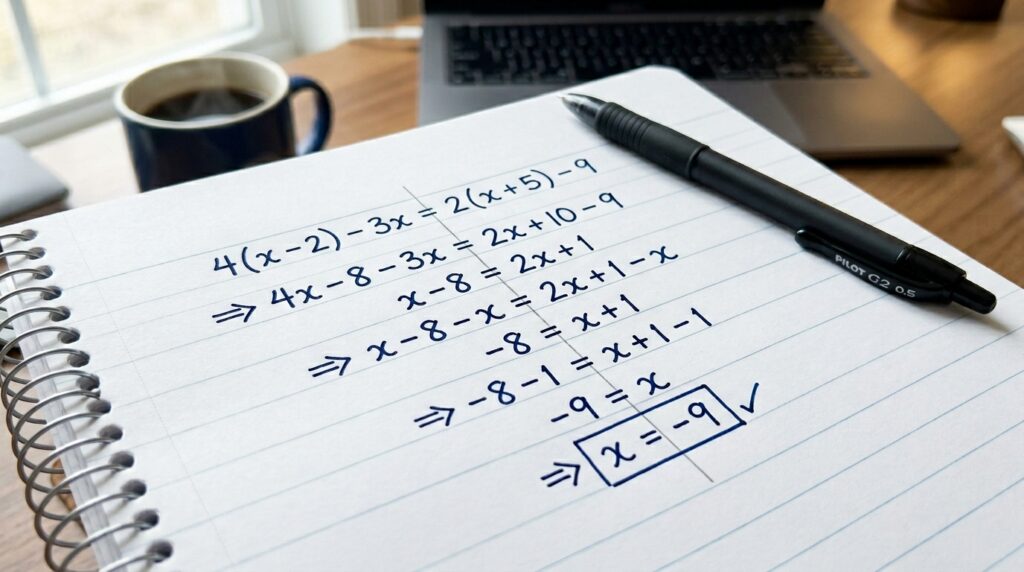
$$4(x – 2) – 3x = 2(x + 5) – 9$$
- Step 1: Clear the parentheses. Distribute the 4 on the left, and distribute the 2 on the right.$$4x – 8 – 3x = 2x + 10 – 9$$
- Step 2: Clean up both sides (Combine like terms).On the left side, we have $4x$ and $-3x$. Combining them gives us $1x$ (or just $x$).On the right side, we have $+10$ and $-9$. Combining them gives us $1$.Now look how much cleaner it looks:$$x – 8 = 2x + 1$$
- Step 3: Move the variables to one side. Our $x$ terms are $1x$ and $2x$. Let’s subtract $1x$ from both sides to keep the variable positive.$$x – x – 8 = 2x – x + 1$$$$-8 = x + 1$$
- Step 4: Isolate $x$. Subtract 1 from both sides to get rid of that $+1$ next to the $x$.$$-8 – 1 = x + 1 – 1$$$$-9 = x$$
Our answer is $x = -9$. Even with a massive equation, following the exact same rhythm pulls the right answer out every single time.
Mistakes That Will Wreck Your Grade (And How to Avoid Them)
When I review algebra homework, 90% of the errors aren’t because the person doesn’t understand equations. They are small, silly slips that snowball into the wrong answer.
1. Dropping the Negative Sign
This is the single most common mistake in algebra history. If you have an equation like $-3(x – 4)$, when you distribute that $-3$, it must multiply by both terms.
- Wrong: $-3x – 12$
- Right: $-3x + 12$ (because a negative multiplied by a negative becomes a positive).
2. Adding Instead of Dividing at the Very End
When people see $4x = 12$, their brain sometimes goes into autopilot and thinks, “To get rid of 4, I need to subtract 4.” They end up with $x = 8$.
Remember, $4x$ means 4 times $x$. The only way to break that bond is with division.
3. Forgetting the “Other Side”
When you’re working fast, it’s easy to subtract a number from the left side and completely forget to do it to the right side. Draw a vertical line straight down from your equal sign all the way down your paper. This creates a visual wall, reminding you that if you drop a number on the left side of the wall, you must drop the exact same weight on the right side.
Tools to Help You Keep Your Sanity
If you are stuck on a problem at 10 PM and can’t figure out why your answer doesn’t match the back of the book, utilize these free resources. Don’t use them to cheat; use them as a digital tutor to find where your steps went off-track.
- Symbolab: A fantastic web-based math solver. Unlike a generic calculator, it shows you the exact step-by-step algebraic breakdown of the problem you type in. It is incredibly helpful for finding the exact line where you made a sign error.
- MathPapa: Specifically designed for algebra, this tool lets you type in linear equations and walks you through the balance-scale steps in plain English.
- Maple Calculator / Photomath: Apps that let you take a picture of a handwritten equation on your notebook paper and instantly see the solution steps. If you use these, challenge yourself to find your mistake before looking at their breakdown.
Finding the Pattern
Linear equations can feel incredibly frustrating when you view them as a jumble of random letters and numbers. But remember: algebra is just a game with a very strict set of rules. As long as you keep the scale balanced, clear out the clutter methodically, and watch your negative signs, the equation will practically solve itself.
Grab a piece of scrap paper, write down a problem, draw your vertical line down the equal sign, and take it one step at a time. You’ve got this.