

It is 11:45 PM on a Sunday night. Your AP US History or 9th-grade Social Studies exam is at 8:00 AM tomorrow. You are sitting at your desk, staring at a 20-page study guide, completely overwhelmed. The Stamp Act, the Townshend Acts, the Intolerable Acts, the battles of Lexington, Saratoga, and Yorktown… they all just blur together into a giant soup of random years, names, and old-timey wigs.
I know that exact feeling of panic because I lived it. Back in school, I tried to memorize the entire American Revolution timeline by brute-force cramming. I stayed up until 3:00 AM repeating “1765 is the Stamp Act, 1773 is the Boston Tea Party” over and over like a broken record.
Want to guess what happened? I walked into the classroom on five hours of sleep, saw the first essay question, froze completely, and mixed up the Coercive Acts with the Declaratory Act. It was an absolute disaster.
That failure forced me to figure out how memory actually works. The human brain is incredibly bad at remembering random numbers and dates on a flat piece of paper, but it is fantastic at remembering drama, locations, and patterns.
If you are panicking about an upcoming history test, close your boring textbook. Here are 5 unconventional, highly effective memory hacks to lock down the American Revolution timeline in your brain before tomorrow morning.
Hack 1: Use the “Netflix Drama” Framework (Cause & Effect Stepladder)
The absolute biggest mistake I made—and that most students make—is trying to memorize historical events as isolated, random dates. History isn’t a list of vocabulary words; it’s a massive, toxic reality TV show where every single episode happens because of what happened in the last episode.
Stop trying to memorize the exact year first. Instead, build a chain of cause-and-effect. Think of it like a Twitter beef or a Netflix series timeline.
The Real-Life Example: The Tax Escalation Chain
Let’s look at the years leading up to 1775. If you try to memorize them separately, you’ll mix up the order. Instead, link them together in a story of escalating anger:
- The Seven Years’ War Ends (1763): Britain beats France but goes completely broke. They need money fast.
- The Stamp Act (1765): Britain decides to tax the colonists’ everyday paper items (legal documents, playing cards). The colonists get furious because they have no say in Parliament (“No taxation without representation”).
- The Townshend Acts (1767): Britain backs off the stamps but immediately tries to sneak in taxes on other everyday stuff like glass, lead, paint, paper, and tea.
- The Boston Massacre (1770): Tensions get so high from the soldiers enforcing these taxes that a street fight breaks out, and British troops fire into an angry mob.
- The Boston Tea Party (1773): Colonists are so fed up with the leftover tea tax that they dress up in disguise, sneak onto British ships, and dump an entire massive shipment of tea directly into the freezing harbor.
- The Intolerable Acts (1774): King George is absolutely livid about the wasted tea. To punish Boston, he shuts down their harbor, cancels their local government, and forces them to house British troops.
Why this works: When you sit down at your exam, if a question asks about the Intolerable Acts, your brain won’t have to scan a random list of years. You’ll think: “Oh, that was the King’s angry punishment right after the Boston Tea Party.” If you know the story, the timeline automatically falls into place.
Hack 2: Anchor the Timeline with “Hero Dates”
You do not need to memorize all fifty dates mentioned in your textbook. That is a trap. If you try to remember everything, you will remember nothing.
Instead, pick three anchor dates—I call them “Hero Dates”—that divide the entire revolution into three clean eras. Once you memorize these three main pillars, every other minor event is easy to place because it either happens right before or right after a Hero Date.
The 3 Pillars of the Revolution
   [ 1775 ] -------------------> [ 1776 ] -------------------> [ 1781 ]
The First Shots            The Breakup Letter           The Final Battle
(Lexington & Concord)     (Declaration of Ind.)            (Yorktown)
- Pillar 1: 1775 (The First Shots) — This is when things get real. No more talking, no more protest letters. The battles of Lexington and Concord happen here. The war officially begins.
- Pillar 2: 1776 (The Official Breakup) — This is the year everyone knows. The Continental Congress writes the Declaration of Independence. They officially tell King George, “It’s not us, it’s you. We are out.”
- Pillar 3: 1781 (The Climax) — The British army gets trapped on a peninsula by George Washington and the French navy at the Battle of Yorktown. General Cornwallis surrenders. The fighting is basically over.
How to use this on the test: If the exam asks you about George Washington crossing the icy Delaware River to surprise Hessian troops at the Battle of Trenton, you don’t need to stress over the exact month. You just think: “Well, Washington was desperate for a win right after they declared independence to keep the army alive.” Boom—it has to be late 1776.
Hack 3: Build a Digital “Memory Palace” with Google Maps
If you are a visual learner, reading text on a page is your worst enemy. Your brain is wired to remember spatial locations way better than numbers. You can use this to your advantage by creating a physical route for the major battles of the war.
When I was struggling to keep the sequence of battles straight, I opened up Google Maps and looked at the actual geography of the East Coast. The war literally moves like a road trip from North to South.
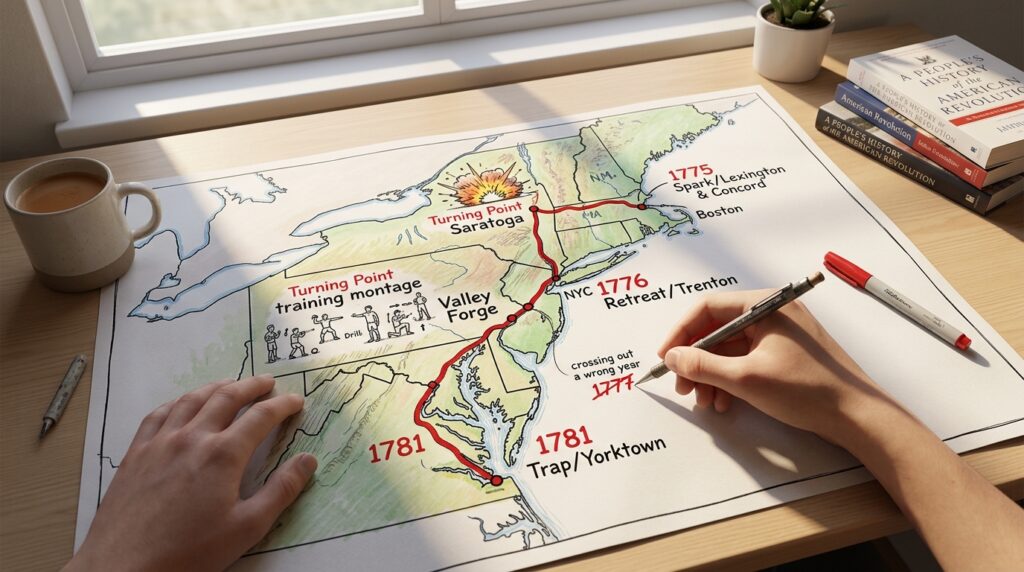
The Visual Road Trip Route:
- Stop 1: Massachusetts (1775) — The spark. Lexington, Concord, and Bunker Hill all happen up north around Boston.
- Stop 2: New York & New Jersey (1776–1777) — The middle ground. Washington loses New York City, retreats across New Jersey, wins at Trenton, and the massive turning point battle happens at Saratoga, NY (which convinces France to join the war).
- Stop 3: The South (1780–1781) — The endgame. The British get tired of fighting up north, so they move south to places like Charleston and Cowpens, eventually getting pushed into Virginia for the final showdown at Yorktown.
Instead of staring at flashcards, spend five minutes tracking this route with your finger on a map. Picture the war starting at the top of the map and slowly sliding down the coastline over a six-year period.
Hack 4: Exploit the “Turning Point” Pivot Trick for Battles
Multiple-choice questions love to trick you on the exact importance of specific battles. You don’t need to know every single tactical detail of how troops moved. You just need to assign a one-word identity to the three major turning points in the middle of the timeline.
If you can link the year to the identity of the battle, you can answer almost any timeline or significance question:
- Saratoga (1777) = The Pivot. This is the most important battle on the entire timeline. The Americans win a shocking victory against a British army coming down from Canada. Why does this year matter? Because when King Louis XVI of France sees this, he says, “Wow, they might actually win this. Let’s send them our navy and money.” * Valley Forge (Winter 1777–1778) = The Training Montage. Right after Saratoga, Washington’s army goes into winter quarters. It’s freezing, they have no shoes, and everyone is dying of disease. But a Prussian guy named Baron von Steuben shows up and trains them into a real military.
- Yorktown (1781) = The Trap. The end of the line.
If a test question asks you about when French ships started helping the colonists, you know it must be right after the turning point of 1777.
Hack 5: The “Blurting Method” active recall sheet
Staring at notes is passive. Passive studying is how you end up staring at a blank wall during an exam wondering where your life went wrong. You need to force your brain to extract information under pressure tonight so it can do it easily tomorrow.
Try the Blurting Method. It takes exactly 10 minutes and gives you an instant reality check on what you actually know.
Step-by-Step Blurting Setup:
- Take a completely blank sheet of printer paper and a black pen. Set a timer on your phone for 4 minutes.
- Without looking at your computer, phone, or textbook, write down every single thing you can possibly remember about the American Revolution timeline. Draw arrows, write names, write years, jot down random battles—just get it out of your head as fast as humanly possible.
- When the timer goes off, stop. Open your study guide or textbook.
- Take a red pen or a bright highlighter and write down all the major things you missed or got out of order directly onto that same sheet of paper.
Seeing your gaps written in bright red ink creates a psychological marker in your brain. Tomorrow morning, when you look at a question about the stamp tax or the continental congress, your brain will instantly remember that red ink correction you made the night before.
3 Fatal Mistakes to Avoid Tonight
As you finish up your last-minute study session, make sure you don’t fall into these common high-school history traps:
- Don’t confuse the First and Second Continental Congress. The First one met in 1774 just to complain about the Intolerable Acts and organize a boycott. The Second one met in 1775/1776 to actually run the war, appoint George Washington as the boss, and sign the Declaration of Independence.
- Don’t waste time memorizing day-specific dates. No teacher expects you to remember that the Declaration of Independence was finalized on July 4th—everyone knows that. Focus entirely on the year and the sequence of events. Knowing that event A caused event B is worth ten times more points than knowing an exact calendar date.
- Don’t skip sleep to memorize minor details. Sleep deprivation actively destroys your working memory. If you stay up until 4:00 AM trying to memorize who won the minor Battle of Guilford Courthouse, you will lack the cognitive focus to write a coherent essay about the major causes of the war. Get at least 6-7 hours.
The Night-Before Reality Check
The American Revolution timeline seems terrifying because textbooks make it look like a list of a hundred dead guys and random laws. But at its core, it is just a story about a government that went broke after a major war, tried to tax its citizens without giving them a political voice, and watched a series of small street protests spiral out of control into a full-blown global conflict.
Anchor your brain around 1775 (the fighting starts), 1776 (the breakup letter), and 1781 (the final trap at Yorktown). Fill in the gaps using cause-and-effect storytelling rather than raw numbers, do a quick round of blurting to check your blind spots, and go to bed. You’ve got this.