
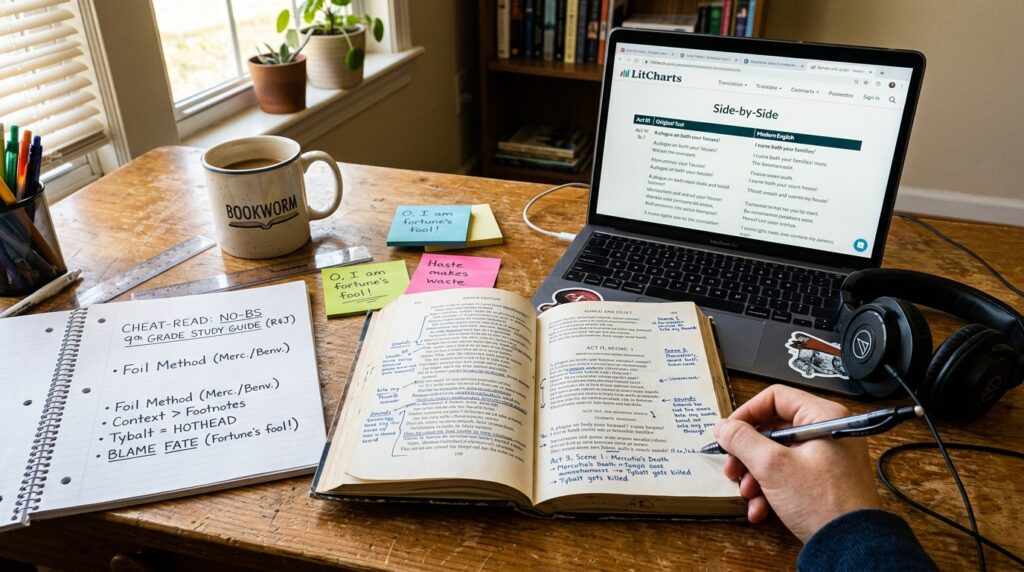
I still remember the exact moment I realized Shakespeare was going to destroy my GPA. I was sitting on my bed, staring at page four of Romeo and Juliet, and honestly, it felt like trying to read a broken Wi-Fi router’s backend code. Words like “wherefore,” “coz,” and “bite my thumb” made absolutely no sense. I spent two hours trying to finish Act 1, fell asleep, and completely bombed the pop quiz the next morning.
That was the day I stopped trying to read Shakespeare the “official” way and figured out how to cheat-read it.
Let’s be clear: when I say “cheat-read,” I don’t mean using AI to write your essay or copying your friend’s homework. That gets you caught. By cheat-reading, I mean using smart tech, modern shortcuts, and psychological hacks to understand the entire play in a fraction of the time, ace your English tests, and actually look like a genius in class discussions without drowning in 400-year-old Early Modern English.
If you are a 9th grader currently staring at a copy of Romeo and Juliet with pure dread, take a deep breath. Here is the ultimate, no-BS guide to surviving it.
Why Reading Shakespeare the Traditional Way is a Trap
Your teacher probably told you to open the book, read every line, and “look at the footnotes if you get confused.”
Let’s honest—that advice is terrible. Footnotes interrupt your brain’s flow. You read a line, you don’t get it, you look down at a footnote, you read the definition, you look back up, and by then, you’ve forgotten who was even speaking.
The biggest mistake I made at first was treating Romeo and Juliet like a standard novel. It isn’t a novel. It’s a play script. It was written to be watched by screaming, drunk people in an open-air theater in London, not analyzed line-by-line under fluorescent classroom lights.
Once you realize that the text is just a blueprint for a chaotic reality TV show full of drama, sword fights, and bad decisions, everything gets a lot easier.
The 3-Step Cheat-Reading System That Saves Hours
This is the exact strategy I used to flip my grades from a D to an A without spending hours staring at old English text. It relies on pre-loading your brain with context before you ever look at the actual assignment.
Step 1: Pre-Game the Plot (Spoiler Alert Everything)
In a normal book, spoilers ruin the fun. In Shakespeare, spoilers are your best friend. Before you start reading any assigned Act or Scene, go look up exactly what happens.
Don’t just read boring summaries. Go to YouTube and look up quick animated breakdowns. Channels like Crash Course Literature or even short 3-minute whiteboard animations give you the baseline plot.
If you already know that Act 3, Scene 1 ends with Mercutio dying and Romeo killing Tybalt, your brain doesn’t have to waste energy wondering “Wait, who is fighting whom right now?” when you open the book. You already know the destination; you’re just skim-matching the words to get there.
Step 2: Use Side-by-Side Translators Wisely
Do not try to raw-dog the original text. Use tools that give you a modern translation right next to the original words.
- No Fear Shakespeare (SparkNotes): The absolute gold standard. It puts the original text on the left and standard, everyday English on the right.
- LitCharts: Incredible for tracking themes and symbols with color-coded layouts.
The Pro Tip: Read the modern translation first to understand the vibe, then quickly glance at the original text. Look for specific, weird words that stand out in the original. Why? Because those weird words are exactly what teachers put on multiple-choice identification quizzes.
Step 3: Listen at 1.5x Speed
Since this is a play, the words are meant to be heard. If you just read the text silently in your head, it sounds flat.
Go to Spotify, YouTube, or Audible and find a full audio drama performance of Romeo and Juliet. Put your headphones on, track the text with your eyes on the page (or screen), and turn the audio speed up to 1.25x or 1.5x.
Hearing professional actors put emotion, anger, and sarcasm into the words makes the meaning instantly clear. When Tybalt sounds genuinely angry in the audio track, you don’t need a footnote to tell you he’s mad.
How to Sound Like an Expert in Class (Without Reading Every Page)
Teachers love class participation. If you speak up once or twice with a solid point, they usually assume you read the whole chapter and will leave you alone for the rest of the week.
To do this without actually reading every single line, you just need to memorize three major themes and one or two specific quotes that back them up.
The “Foil” Trick
A “foil” is a character who is the exact opposite of another character, making their traits stand out more. In Romeo and Juliet, you don’t need to memorize everyone. Just remember these pairs:
- Romeo vs. Mercutio: Romeo is a hopeless romantic who cries about love; Mercutio thinks love is a joke and just wants to hang out and fight.
- Tybalt vs. Benvolio: Tybalt is a hothead who loves violence; Benvolio is the peacemaker who tries to stop fights.
If the teacher asks a question about character dynamics, just raise your hand and say: “It’s interesting how Benvolio’s attempt to keep the peace acts as a perfect foil to Tybalt’s immediate desire for conflict in Act 1.” Boom. You just won the class for the day.
The Fate Theme
Whenever you are stuck on an essay topic or a discussion question, blame Fate. Shakespeare drops massive hints throughout the entire play that these two kids are doomed from the start (they are literally called “star-crossed lovers” in the first two minutes of the prologue).
If an exam asks why a certain tragedy happened, don’t just say it was bad luck. Write about how the characters were trapped by the ancient feud and the inescapable wheel of fate. Teachers eat that up.
4 Common Mistakes That Will Blow Your Cover
If you’re going to cheat-read, you have to do it smartly. Avoid these absolute rookie mistakes:
1. Copy-Pasting Directly from Analysis Sites
If you use a phrase like “Shakespeare utilizes juxtaposition to illuminate the transient nature of youth” in your essay, but you normally talk like a regular teenager, your teacher is going to know instantly. They have plagiarism checkers, and worse, they know your writing style. Rewrite every single insight into your own voice.
2. Confusing the Characters
Because a lot of names start with the same letters, it’s easy to mess up. I once wrote half an essay confusing Benvolio (Romeo’s nice cousin) with Paris (the guy Juliet was supposed to marry). It was embarrassing. Double-check your character map before you write anything down.
3. Missing the Context of “Wherefore”
This is the biggest trap in the whole play. In the famous balcony scene, Juliet says, “O Romeo, Romeo! wherefore art thou Romeo?” * The Rookie Mistake: Thinking “wherefore” means “where.” (e.g., thinking she is looking for him).
- The Real Meaning: “Wherefore” means “Why.” She is asking why he has to be a Romeo (a Montague, her family’s enemy). Remember this one specific fact, because it is guaranteed to be a question on your unit test.
4. Relying on the 1996 Leonardo DiCaprio Movie Alone
While the movie is awesome and helps you visualize the chaos, it cuts out huge chunks of the actual text and shifts scenes around. If you only watch the movie and don’t look at the text summaries, you will write about things that aren’t in the book format your teacher is grading.

Step-by-Step Cramming Guide: Night Before the Test
If you have a major exam tomorrow morning and you haven’t read a single page, do not panic. Do this exact routine tonight:
| Time | Action Item | Target Source |
| 0:00 – 0:15 | Read the 5-minute summary of the whole play to remember who dies and when. | SparkNotes / LitCharts |
| 0:15 – 0:45 | Watch a fast-paced video recap of each Act. Focus heavily on Act 3 (the turning point). | YouTube |
| 0:45 – 1:15 | Memorize three major quotes about “stars,” “light,” or “death” and know who said them. | BrainyQuote / LitCharts |
| 1:15 – 1:30 | Read the Prologue line-by-line. Teachers love testing the Prologue because it sets up everything. | No Fear Shakespeare |
The Real Truth About This Play
Here is the ultimate secret no one tells you in high school: Romeo and Juliet isn’t actually a sweet, slow, romantic love story. It’s an action-packed thriller that takes place over the span of just four days, involving a bunch of teenagers who make terrible choices because they lack impulse control, ending with six dead bodies.
When you stop looking at it like a holy piece of ancient literature and start looking at it like a fast-moving drama, it actually becomes kind of entertaining.
Don’t let the old language intimidate you. Pre-game the plot, keep your side-by-side translations open, focus on the major character clashes, and you will get through this unit with your sanity—and your GPA—completely intact.