
A couple of years ago, I was upgrading the storage on my main desktop computer. I decided to combine a fast, modern solid-state drive (SSD) and a massive, old-school mechanical hard drive into a single, unified storage pool using a software trick. On paper, it sounded incredibly efficient.
In reality, it was a total nightmare. The two drives ran on completely different speeds, processed data differently, and used incompatible file systems. They constantly glitched, threw error codes, and fought each other for control. Eventually, the entire system locked up, crashed, and corrupted half my files. I had to completely wipe the computer, throw out the old drive, and rebuild the operating system from scratch.
That messy computer crash is the closest real-world analogy I can think of for what happened to the United States in the mid-1800s.
The country was trying to run two completely different, incompatible economic and social operating systems under one roof. The North was moving fast into a modern, industrial economy fueled by factories and railroads. The South was locked into a massive, agricultural economy completely dependent on the brutal, systemic institution of human slavery.
They used different systems, held different values, and constantly fought for control over the federal government. Eventually, the fragile software holding the union together snapped, causing the deadliest system crash in American history: the American Civil War.
When you open a 9th-grade history textbook, this entire era is hidden behind a mountain of confusing legislative compromises, old political party names, and endless troop movement maps. It feels completely impossible to memorize for a midterm exam.
But once you strip away the dense academic jargon, the Civil War is a clear, step-by-step story of a house splitting at its foundation, collapsing under its own weight, and undergoing a violent, painful rebuild. Let’s break down the actual root causes, walk through the official chronological timeline, and look at the massive ripples it left behind using plain, everyday language.
The Root Causes: The Three Fault Lines
Before memorizing specific dates or battle locations, you have to understand the three underlying forces that pushed the states into open war. If you focus on these three pillars in an essay, you will always get full marks.
1. The Moral and Economic Conflict of Slavery
This is the absolute foundation of the entire conflict. The Southern economy was entirely built around labor-intensive cash crops like cotton and tobacco. To maximize profits, Southern plantation owners relied on the forced, unpaid labor of millions of enslaved African Americans. The North, which had outlawed slavery over time, viewed this system as a moral abomination and an economic threat to free working-class citizens. Every single political argument during this era eventually circled back to this core dispute.
2. The Fight Over Western Expansion
Here is the classic point that trips up students on multiple-choice quizzes: The war didn’t start because the North tried to ban slavery in the South instantly. The explosive argument was actually about the future map.
As America took over new western territories (like Kansas, Nebraska, and California), a massive political chess match broke out in Washington, D.C.
- The South demanded that slavery be allowed to expand into the new western lands so they could maintain political power in Congress.
- The North demanded that the west remain “free soil” for independent, non-slave-owning farmers. Every time a new state applied to join the union, it threatened to break the delicate balance of power.
3. States’ Rights vs. Federal Supremacy
The two sides held fundamentally different views on how the US Constitution actually worked. Southern political leaders argued for “States’ Rights,” claiming that individual states were completely sovereign and had the right to ignore (nullify) any federal law they didn’t like. The North argued for “Federal Supremacy,” stating that the union was permanent and that federal laws were the ultimate rules of the land, period.
The Timeline: From Broken Deals to Open War
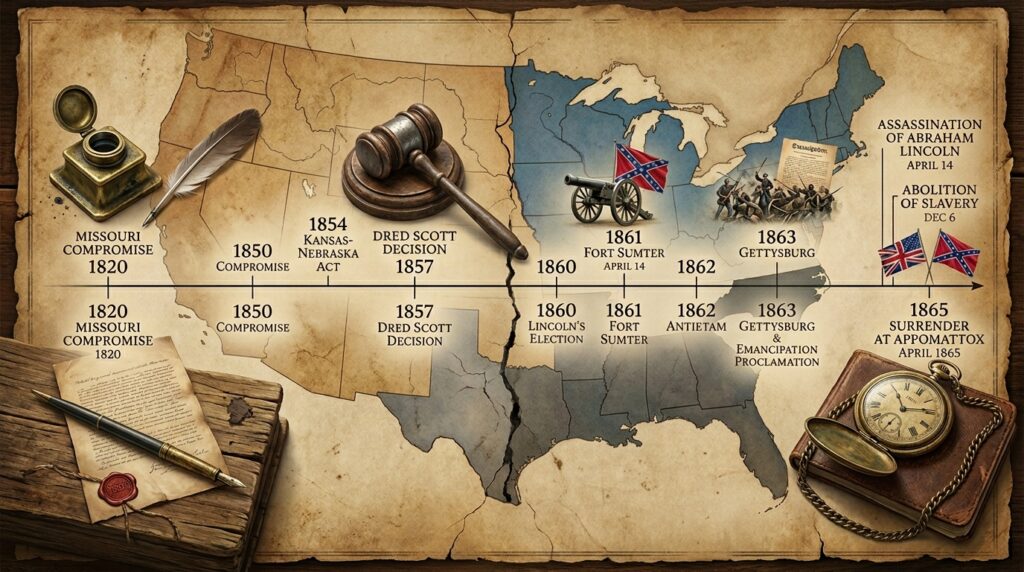
The Civil War didn’t happen out of nowhere. It was a slow, agonizing escalation across forty years of broken political deals. Let’s look at the actual chronological sequence of events.
The Missouri Compromise
March 1820
The first major band-aid on the map. To keep the peace, Congress draws an imaginary horizontal line across the country. Any new state joining north of the line must be free; any state joining south of it can allow slavery. It delays the war but satisfies no one.
The Compromise of 1850 & The Fugitive Slave Act
September 1850
A massive legislative trade. California joins as a free state, but in return, the South gets a brutal federal law called the Fugitive Slave Act. This law forces northern citizens and police officers to catch and return escaped enslaved people under penalty of heavy fines or jail. It outrages northerners and brings the reality of slavery straight to their front doors.
The Kansas-Nebraska Act
May 1854
Congress discards the old Missouri Compromise line and decides to let voters in new territories vote on whether to allow slavery themselves (a concept called “popular sovereignty”). This causes a violent local mini-war known as “Bleeding Kansas,” as pro-slavery and anti-slavery groups rush into the territory and start killing each other over the vote.
The Dred Scott Decision
March 1857
The Supreme Court drops a political nuclear bomb. They rule that Scott, an enslaved man suing for his freedom, is property and not a citizen, meaning he has zero rights in a courtroom. The court goes a step further and declares that Congress has absolutely no legal right to ban slavery in any western territory, rendering all previous political compromises unconstitutional.
The Election of Abraham Lincoln
November 1860
The absolute breaking point. Abraham Lincoln, running on a platform committed to stopping the expansion of slavery into the west, wins the presidency without winning a single Southern state. Viewing this as an existential threat, South Carolina officially quits the United States (secedes) in December, followed quickly by ten other Southern states to form the Confederate States of America.
The Attack on Fort Sumter
April 12, 1861
The official start of the war. Confederate cannons open fire on a federal military fort in South Carolina. Lincoln calls for troops to put down the rebellion, and the deadliest conflict in American history officially begins.
The Emancipation Proclamation
January 1, 1863
President Lincoln signs an executive order that changes the entire meaning of the war. It declares that all enslaved people living inside rebel-controlled Confederate territory are now legally free. It transforms the union mission from a simple war to preserve the map into a grand moral crusade to destroy slavery forever.
The Battle of Gettysburg
July 1-3, 1863
The bloody turning point of the war. Confederate General Robert E. Lee marches his army deep into northern territory (Pennsylvania) in a desperate attempt to force a peace deal. The Union army wins a massive, brutal three-day battle, breaking the back of the Confederate military. From this point on, the South is constantly retreating.
The Surrender at Appomattox
April 9, 1865
The final scene. Completely surrounded, out of supplies, and facing starving troops, Confederate General Lee surrenders his army to Union General Ulysses S. Grant at a small courthouse in Virginia, effectively ending the war. Less than a week later, President Lincoln is assassinated.

The Consequences: Rebuilding the Broken System
When the smoke cleared in 1865, over 600,000 Americans were dead, the entire Southern infrastructure was physically destroyed, and the country had to figure out how to function as a unified nation again. This painful era is called Reconstruction.
When you write an essay on the effects of the Civil War, structure your thoughts around these three massive institutional changes:
| The Institutional Shift | What Changed Permanently? | The Real-World Impact |
| The 13th Amendment (1865) | Complete Abolition | Constitutionally outlaws slavery across every single inch of the United States forever, freeing 4 million people. |
| The 14th Amendment (1868) | Birthright Citizenship | Declares that anyone born on US soil is a full citizen and guarantees that everyone receives equal protection under the law. |
| The 15th Amendment (1870) | Voting Freedom | Explicitly bans the government from denying a citizen the right to vote based on their race, color, or previous condition of servitude. |
The Bitter Reality: While these three baseline patches to the Constitution looked incredible on paper, the transition was incredibly messy. As soon as federal troops left the South at the end of Reconstruction, white Southern politicians implemented a devastating loop of local laws called Jim Crow laws. These rules used poll taxes, literacy tests, and violent intimidation to systematically strip Black citizens of their new constitutional rights for another hundred years.
Common Mistakes That Cost Points on History Tests
When reviewing your class study guides or filling out study loops on platforms like Quizlet, make sure you don’t fall into these three classic historical trapdoors:
1. Falling for the “Tariff/Tax Only” Myth
You will occasionally see old articles or videos claiming the Civil War was just an argument over northern industrial tariffs and taxes, completely ignoring slavery. This is completely inaccurate. If you look at the actual legal secession documents written by the Southern states in 1860, they explicitly name the preservation of human slavery as their primary reason for breaking away. Always back your arguments up with those primary sources.
2. Confusing the Emancipation Proclamation with the 13th Amendment
This is a favorite multiple-choice trick for history teachers.
- The Emancipation Proclamation was a temporary war measure that only freed enslaved people living inside states that were actively rebelling against Lincoln. It didn’t apply to slave-owning states that stayed loyal to the Union (like Maryland or Kentucky).
- The 13th Amendment is the actual permanent tool that outlawed slavery everywhere across the entire map, inside both the North and the South.
3. Thinking the War Ended Segregation
Do not write that Lincoln’s victory instantly fixed race relations in America. The end of the Civil War successfully ended the legal institution of slavery and preserved the geographic union, but it left the deep cultural issues of systemic racism, segregation, and economic inequality completely unsolved.
Free Digital Tools to Help You Ace Your Midterm
If trying to memorize a massive list of 19th-century dates and battle maps from a dry printout sheet is burning you out, step away from the desk and check out these brilliant interactive platforms:
- The Civil War Battle Maps App (by American Battlefield Trust): An incredible, free smartphone app that features detailed GPS-enabled maps of major battlefields like Gettysburg and Antietam. You can track troop movements phase-by-phase, watch high-quality video breakdowns, and see animations of tactical decisions. It makes battle strategy incredibly intuitive to look at.
- Digital History (University of Houston): An exceptional, free online database packed with actual primary sources from the Civil War era. You can read original letters written by ordinary soldiers, look at historical photographs, and read the actual diary entries of people living through the homefront. Using these raw details in an essay instantly upgrades your grade.
The Final Takeaway
The American Civil War looks incredibly intimidating when you treat it like an endless list of dry legislation names and military casualty numbers to memorize for a rubric grade. But once you change your perspective, you realize it is the core origin story of the modern United States.
It was the violent, devastating moment where the country finally had to confront its foundational flaw, wipe the old economic operating systems, and commit to building a completely new framework on paper. Keep the underlying fault lines in mind, track the timeline step-by-step through cause and effect, and you will navigate your 9th-grade history units with absolute ease.