
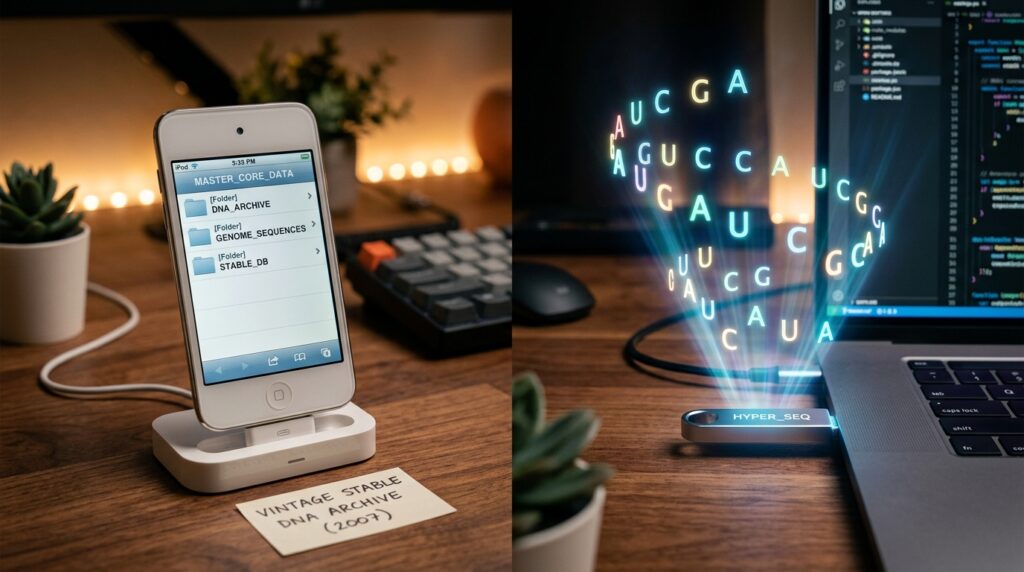
I was digging through an old plastic storage bin in my closet last weekend when I found my ancient, brick-sized 64GB iPod Touch from high school. To my absolute shock, it booted up when I plugged it into a charger. I swiped through the music library and found a massive, messy folder titled “Project_Backup_2012.” Inside were raw audio tracks, digital artwork, and text files for a terrible garage band my friends and I started.
If I lost that iPod, that music would disappear forever. It held the master blueprint. But because I wanted to share one of those cringe-worthy tracks with a friend across the country, I didn’t mail him the physical iPod. Instead, I copied the raw track file onto a flash drive, compressed it into a shareable MP3 link, and messaged it to him. He used that temporary file to play the music on his phone speaker.
As I was explaining this backup process to my younger nephew—who happened to be stressing out over a 9th-grade biology test on nucleic acids—a lightbulb went off.
“Look at it this way,” I told him, pointing to the old device. “Your body does the exact same thing every second. Your DNA is that old iPod sitting safely in the vault. It holds the master code for absolutely everything you are, but it never leaves its room. Your RNA is that temporary MP3 link. It copies a tiny slice of the master code and runs across the cell to actually play the music.”
When you read a biology textbook, DNA and RNA look like a nightmare of organic chemistry terms: deoxyribonucleic acid, phosphodiester bonds, purines, and pyrimidines. It feels like trying to read software code without a manual.
But once you strip away the heavy academic gatekeeping, these two molecules are just a beautifully organized data storage and delivery system. Let’s break down DNA and RNA simply, look at their critical differences, and map out exactly how they work together using plain human language.
DNA: The Master Hard Drive
Let’s start with the big one: DNA (Deoxyribonucleic Acid).
DNA is your body’s ultimate archive. It contains the instructions for making every protein that builds your muscles, colors your eyes, keeps your heart beating, and determines how your body fights off a cold.
The Structure: The Spiral Staircase
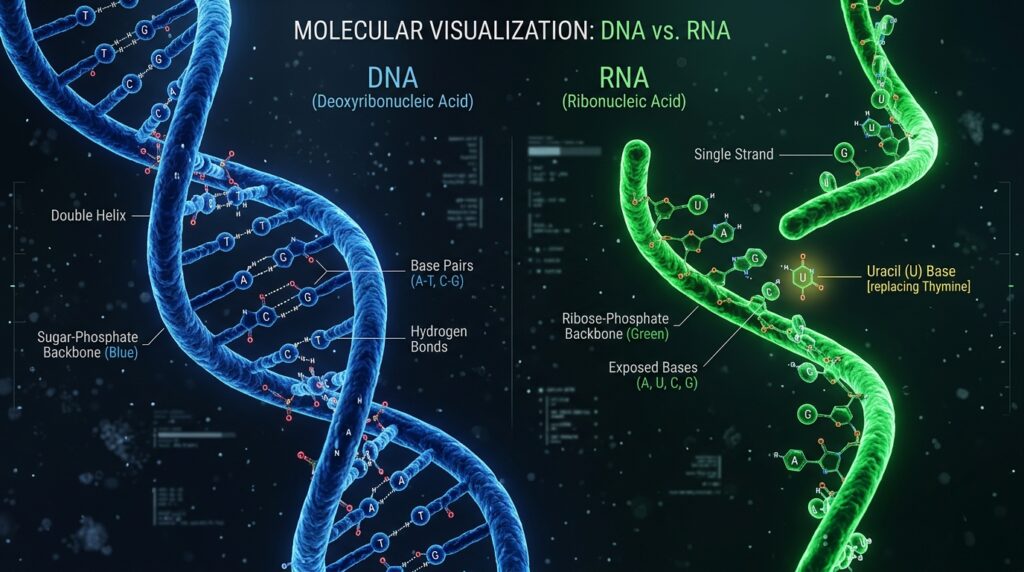
If you look at DNA under an ultra-powerful microscope, it looks like a long, twisted ladder. Scientists call this shape a double helix.
Plaintext
    |--|         A <===> T  (Always Pairs)
   /    \
  |------|       G <===> C  (Always Pairs)
   \    /
    |--|
The outside handrails of this ladder are made of a tough sugar-phosphate frame. But the real magic lies in the rungs of the ladder. These rungs are built from four chemical building blocks called nitrogenous bases:
- A (Adenine)
- T (Thymine)
- C (Cytosine)
- G (Guanine)
The Base-Pairing Law
These four letters follow a very strict social rule. They can only bond with one specific partner across the ladder rung.
- A always pairs with T
- C always pairs with G
How to Memorize It Instantly: Think of locations. Apple in the Tree (A with T), and Car in the Garage (C with G). If a test question gives you one side of a DNA strand that reads
A-T-C-G, you automatically know the matching opposite side readsT-A-G-C.
RNA: The Specialized Messenger
If DNA is the master hard drive, RNA (Ribonucleic Acid) is the single-use USB flash drive.
DNA is incredibly stable and protected inside the nucleus city hall, but it is too big and too valuable to travel out to the cellular factories where proteins are physically constructed. The cell solves this by making a lightweight, temporary copy of the specific instruction it needs. That copy is RNA.
The Structural Shifts
While RNA looks similar to DNA, it makes three critical changes to its design:
- Single-Stranded: Instead of a bulky, double-sided twisted ladder, RNA is a nimble, single-sided strand. It looks like someone took a knife and sliced a DNA ladder straight down the middle.
- The Sugar Shift: DNA uses a sugar called deoxyribose. RNA uses a slightly different sugar called ribose. (This is what changes the first letter of their names).
- The Letter Swap (The Biggest Test Trap): RNA keeps A, C, and G, but it completely drops the letter T (Thymine). In its place, RNA uses a replacement base called U (Uracil).
The Rule for RNA Pairing: When RNA reads a DNA strand to make a copy, A no longer pairs with T. Instead, A pairs with U.
The Side-by-Side Comparison
When you are reviewing for a unit test or trying to double-check your flashcards, you need a quick visual cheat sheet. Let’s look at the core differences between the two molecules side-by-side.
| Feature / Trait | DNA | RNA |
| Full Name | Deoxyribonucleic Acid | Ribonucleic Acid |
| Shape | Double Helix (Two strands) | Single Strand |
| Sugar Used | Deoxyribose | Ribose |
| Nitrogen Bases | Adenine, Thymine, Cytosine, Guanine | Adenine, Uracil, Cytosine, Guanine |
| Base Pairing Rule | $A-T$ and $C-G$ | $A-U$ and $C-G$ |
| Location | Locked inside the Nucleus | Built in the nucleus, moves to Cytoplasm |
| Lifespan | Permanent (Lasts the cell’s life) | Temporary (Destroyed after use) |
The 3 Types of RNA: The Cellular Assembly Line
RNA isn’t just one single molecule; it operates as a three-part team to turn the DNA code into physical reality. This process is called the Central Dogma of biology.
1.mRNA (The Messenger):Step 1.
Inside the nucleus, a molecular machine unzips a section of DNA. A strand of messenger RNA (mRNA) is built against the exposed DNA letters. The mRNA acts like a photocopy of a recipe, slips out through a pore in the nucleus wall, and heads to the construction zone.
2.rRNA (The Factory Floor):Step 2.
The mRNA strand arrives at a ribosome. The ribosome is built out of ribosomal RNA (rRNA) and structural proteins. Think of rRNA as the physical workbench or factory floor that holds the mRNA recipe steady so it can be read.
3.tRNA (The Delivery Truck):Step 3.
The ribosome reads the mRNA strand three letters at a time (called a codon). Outside the factory, transfer RNA (tRNA) acts like a delivery courier. Each tRNA molecule carries a specific amino acid (a protein building block) on its back. It checks the mRNA code, matches its own sequence, drops off its cargo, and leaves to fetch another.
Once the tRNA trucks finish dropping off their amino acid packages in the exact order specified by the mRNA recipe, those blocks link together, fold up into a specific shape, and boom—you have a working protein.
Mistakes That Cost Points on Biology Exams
Having helped multiple students troubleshoot their biology homework, I see the same three errors show up on graded worksheets constantly. Avoid these traps:
1. Writing “T” in an RNA Sequence
If a test question asks you to transcribe a DNA strand into an RNA strand, your brain will want to use standard DNA base-pairing automatically.
- DNA Strand:
T - A - C - G - Wrong RNA Transcription:
A - T - G - C - Right RNA Transcription:
A - U - G - CRemember, Uracil ($U$) replaces Thymine ($T$) completely whenever you are writing an RNA strand.
2. Confusing the Locations
Students often forget that DNA is strictly grounded. It is a massive macromolecule that cannot fit through the protective pores of the nucleus. It never enters the cytoplasm or touches a ribosome. Only RNA can move between both worlds.
3. Misinterpreting the “Sugar” Difference
Make sure you know that the “Deoxy” in Deoxyribose literally means “missing one oxygen atom” compared to the Ribose sugar in RNA. It’s a tiny atomic difference, but it’s a favorite trivia question for teachers looking to hand out bonus points.
Free Digital Tools to See it Live
If trying to trace static letter sequences like A-A-U-C-G-U on a monochrome worksheet is making your eyes blur, try these excellent free interactive platforms to watch the molecular dance happen in real-time:
- Learn.Genetics (University of Utah): This is one of the greatest educational science websites on the internet. They have an interactive module called “Transcribe and Translate a Gene” where you can use your keyboard to manually pair RNA bases against a DNA strand and watch the amino acid chain grow on screen. Seeing it react instantly makes the pattern click.
- Nova RNA Virtual Lab: An immersive online interactive lab tool where you can solve molecular puzzles by designing custom RNA strands to fix cellular problems. It plays like a video game but teaches authentic molecular biology mechanics.
The Big Picture
At first glance, molecular biology looks like an overwhelming collection of foreign chemical tags and complicated charts. But at its core, it’s just a beautiful data management pipeline.
Your DNA acts as the secure, permanent master archive locked safely in the server room. Your RNA is the agile, temporary copy that takes the code out to the production floor to build the physical structures of life. Keep the base-pairing laws in mind, watch out for the Uracil swap, and you’ll find that code isn’t nearly as hard to crack as it looks.