
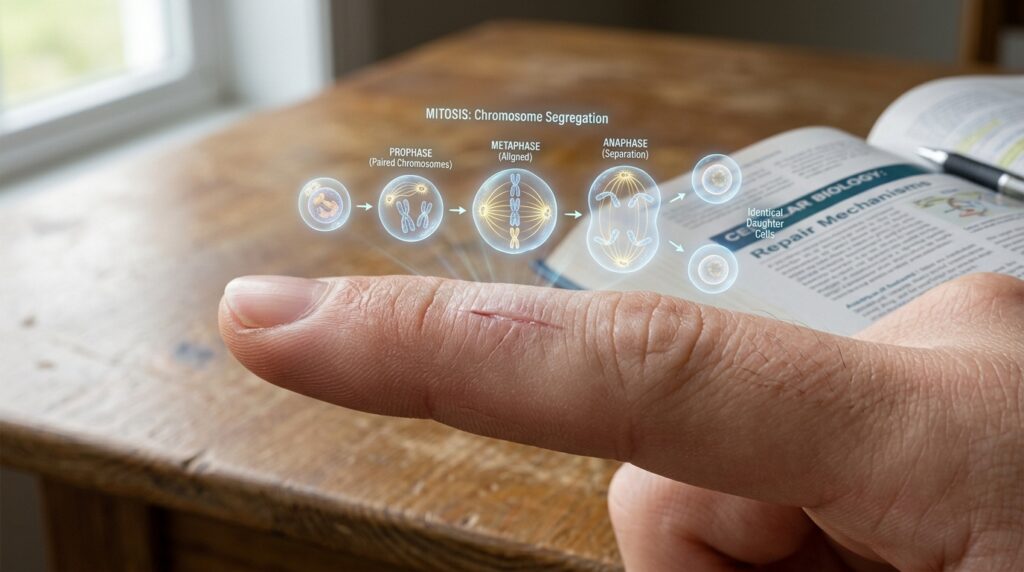
A few months ago, I accidentally sliced my index finger open while trying to pry apart two frozen burger patties with a butter knife. It wasn’t deep enough to need stitches, but it bled a lot and left a nasty, jagged gap in my skin.
Over the next two weeks, I watched my body do something incredible. Day by day, the gap got smaller. New skin cells filled the trenches, knitted together, and eventually left me with a tiny, faint scar.
Right around that same time, my youngest cousin was sitting at my desk, practically pulling her hair out over a 9th-grade biology study guide. She looked at me, completely overwhelmed, and asked, “What is the difference between mitosis and meiosis? They sound exactly the same, they have almost the same steps, and I keep swapping them on my practice quizzes!”
I pointed to the healing cut on my finger. “See this skin right here? This is mitosis in action. My body is making exact carbon copies of my skin cells to patch up the damage.” Then, I tapped the family photo sitting on my desk. “But why you have your dad’s eyes and your mom’s smile? That is the work of meiosis.”
The two processes can feel incredibly confusing because they share a lot of the same vocabulary—prophase, metaphase, anaphase, telophase. But once you understand their completely different biological missions, the confusion vanishes.
Whether you’re a high school freshman trying to save your biology grade, a parent trying to explain cellular division without looking at a textbook, or someone looking for a clear, straightforward breakdown, let’s look at exactly how these two types of cell division stack up.
The Core Missions: Clone vs. Create
To keep your sanity while studying, remember that your body divides cells for two completely different reasons: growth/repair and reproduction.
Mitosis: The Great Cloner
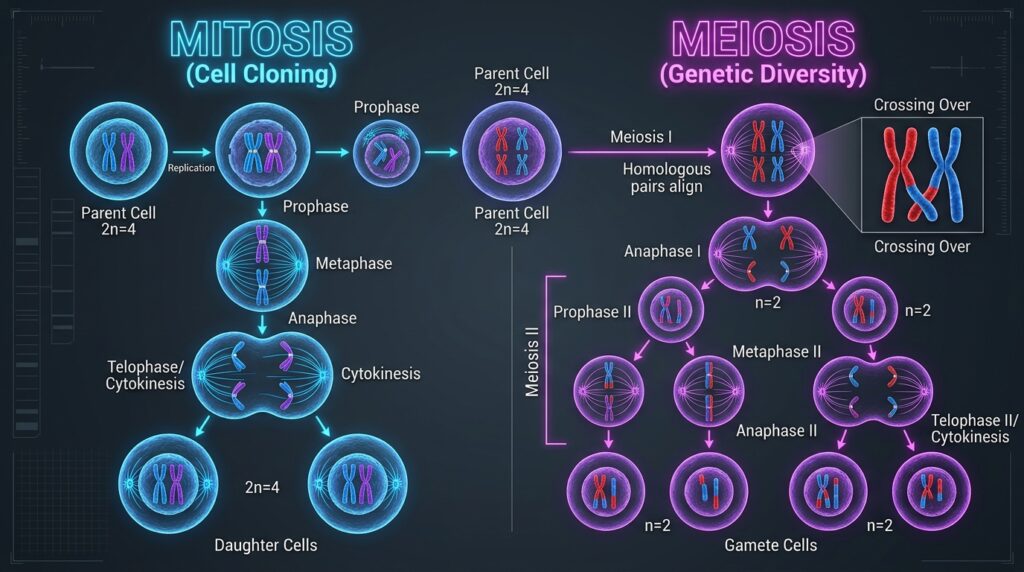
Think of mitosis as a high-speed office copy machine. Its sole job is to take one existing cell and make an exact, identical genetic duplicate of it.
When you grow taller, your body uses mitosis. When you scrape your knee and need new skin, your body uses mitosis. If the new cell isn’t a perfect clone of the old one, it’s a failure.
Meiosis: The Diversity Engine
Meiosis has an entirely different job. It doesn’t create clones. Its purpose is to create unique sex cells (sperm and egg cells, known scientifically as gametes) for reproduction.
Instead of making identical copies, meiosis intentionally shuffles the genetic deck so that every single egg and sperm cell produced is completely unique. This genetic mixing is the reason why you don’t look like an exact clone of your siblings, even though you share the same parents.
The Complete Comparison Chart
When you’re trying to review right before a quiz walks through the classroom door, you don’t want to scan through pages of paragraphs. Here is a high-yield comparison chart that summarizes the most important differences tested in 9th-grade biology.
| Feature / Trait | Mitosis | Meiosis |
| Primary Purpose | Growth, tissue repair, asexual reproduction | Sexual reproduction (creating sperm and eggs) |
| Where It Happens | Somatic cells (body cells like skin, muscle, blood) | Germ cells (inside ovaries and testes) |
| Number of Divisions | 1 single round of division | 2 consecutive rounds (Meiosis I and Meiosis II) |
| Daughter Cells Produced | 2 daughter cells | 4 daughter cells |
| Genetic Identity | Completely identical clones ($100\%$ match) | Genetically unique, diverse variations |
| Chromosome Count | Diploid ($2n$) — Keeps the full set (46 in humans) | Haploid ($n$) — Cuts the set in half (23 in humans) |
| Crossing Over? | No, chromosomes never swap pieces | Yes, during Prophase I (genetic shuffling) |
Deep Dive: The Diploid vs. Haploid Trick
If there is one thing that causes 9th-grade students to lose points on unit exams, it is getting tripped up by the terms diploid and haploid. The math behind this is very simple, but the vocabulary sounds intimidating.
Let’s use human cells as our reference point. A normal body cell (like a liver cell or a brain cell) contains 46 chromosomes packed inside the nucleus. This full set of chromosomes is called the diploid number (abbreviated as $2n$). You got 23 of these from your mom and 23 from your dad.
- Mitosis keeps the count identical: A skin cell with 46 chromosomes divides. The resulting two new skin cells must have 46 chromosomes each.
- Meiosis cuts the count in half: Imagine if a sperm cell had 46 chromosomes and an egg cell had 46 chromosomes. When they joined together, the baby would have 92 chromosomes—a biological disaster. To avoid this, meiosis deliberately cuts the chromosome number in half, down to 23 chromosomes. This half-set is called a haploid cell (abbreviated as $n$).
A Memory Trick: Think of the first letters. Diploid means Double the set (the full amount). Haploid means Half the set.
The PMAT Stages: How It Actually Happens
Both processes use the exact same stages to move chromosomes around, a sequence easily remembered by the acronym PMAT.
If you are looking at cell division diagrams under a microscope or on an interactive study tool, this sequence walks through what is happening inside the cell:
1.Prophase (The Packing Stage):P is for Prophase.
The DNA inside the nucleus condenses from a messy pile of yarn into tight, neat, X-shaped packages called chromosomes.
- Meiosis Twist: In Meiosis, during Prophase I, the chromosomes hug their partners and swap random pieces of DNA. This is a massive event called crossing over.
2.Metaphase (The Middle Stage):M is for Metaphase.
The chromosomes line up in a perfect single-file line straight down the Middle of the cell. Tiny cellular ropes (spindle fibers) attach to the center of each X.
3.Anaphase (The Away Stage):A is for Anaphase.
The spindle fibers contract, ripping the X-shaped chromosomes apart and pulling the pieces Away from each other toward opposite ends of the cell.
4.Telophase (The Two-Cell Stage):T is for Telophase.
The cell pinches in the middle, new nuclei form around the separated DNA packages, and the cell finally splits into Two separate units (a process called cytokinesis).
The Big Difference in Execution: Mitosis goes through PMAT once and stops. Meiosis goes through PMAT, splits the cell into two, and then immediately runs through a second round of PMAT (Meiosis II) without duplicating the DNA again. This second division is what cuts the chromosome number in half and gives you 4 unique cells at the end.
Common Mistakes to Dodge on Test Day
When reviewing flashcards or filling out study sheets, make a mental note to avoid these three classic misunderstandings:
- Thinking Meiosis Happens Everywhere: Meiosis only happens in one highly specific place inside reproductive organs. Every other cell division in your body—from your bone marrow producing new blood cells to your hair growing longer—is purely mitosis.
- Forgetting “Crossing Over” Only Happens in Meiosis: If a test question asks about “crossing over” or “genetic recombination,” the answer is never mitosis. Mitosis is about making perfect copies; swapping pieces would ruin the clone. Crossing over is an exclusive feature of Meiosis I.
- Miscounting the End Products: Remember that mitosis leaves you with two cells, while meiosis leaves you with four cells at the very end of its double-division run.
Tools to Master This Visually
If you are having a hard time picturing these chromosomes lining up and pulling apart, drop the static text diagrams and check out these free online apps:
- Amoeba Sisters YouTube Channel: They have fantastic, short, cartoon-style animated videos specifically breaking down Mitosis vs. Meiosis. Their visuals make the chromosome movements incredibly easy to track.
- Kahoot! / Quizlet: Search for “9th Grade Mitosis vs Meiosis” flashcard sets. Testing your ability to recognize the different visual layouts of metaphase I vs. regular metaphase is the best way to prepare your brain for an actual exam.
Keeping It Straight
Cellular division sounds heavy because of the overlapping vocabulary, but it boils down to a clear division of labor.
If your body needs to grow, heal a wound, or replace an old cell, it runs mitosis to create a perfect identical clone. If your body needs to prepare for the genetic lottery of sexual reproduction, it runs meiosis to cut the chromosome count in half and introduce beautiful variation.
Keep your PMAT steps in order, watch your diploid and haploid definitions, and you will navigate your biology exams with complete confidence.