
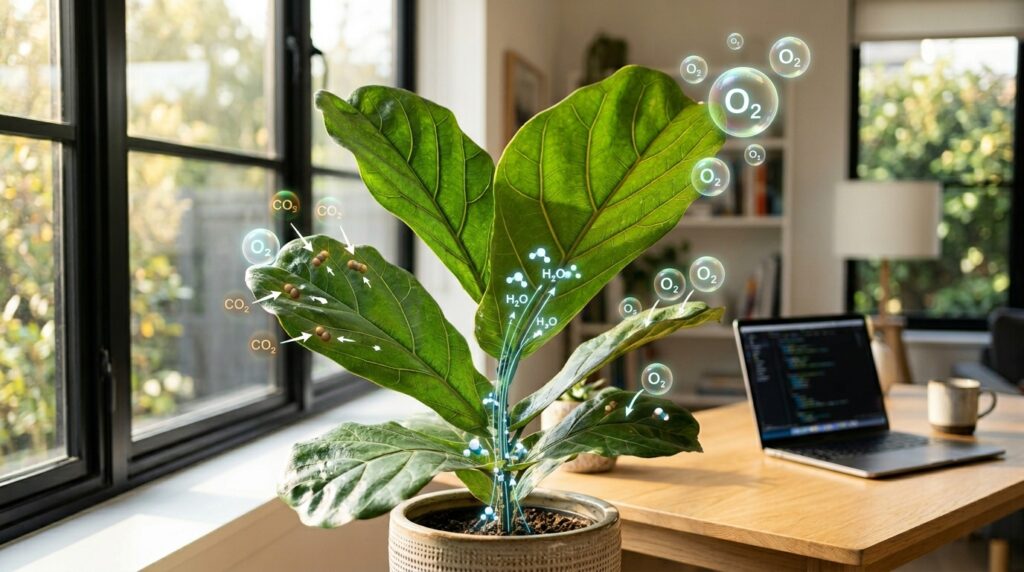
I bought a beautiful, leafy fiddle-leaf fig plant for my home office setup last winter. I set it right next to my desk, bought a sleek smart-watering app to track its moisture levels, and made sure it looked pristine in the background of my video calls.
But within three weeks, it started dropping leaves like crazy. The vibrant green turned into a dull, sickly yellow.
I called my neighbor, an absolute plant wizard who runs a local community greenhouse. She walked into my office, took one look at the heavy, dark velvet curtains blocking my window, and sighed. “You’re starving it,” she said. “You’re watering it perfectly, but it has zero access to light. It can’t make its food, which means its power plants are shutting down.”
She helped me move it right in front of a big, south-facing window. Within a month, new bright green buds started popping up.
Watching that plant fight its way back to life reminded me of a massive headache my teenage cousin went through during his 9th-grade biology midterms. He was staring at two massive chemical formulas for photosynthesis and cellular respiration, completely frantic. “They look like two different languages,” he complained. “I keep mixing up what goes in and what comes out!”
I grabbed a scrap piece of paper and wrote the two equations down, one right above the other. “Look closer,” I told him. “They aren’t two different languages. They are the exact same language, just written completely backward. They are two halves of the ultimate global energy loop.”
When you read a biology textbook, these two processes are hidden behind a mountain of terrifying vocabulary: thylakoids, cristae, the Calvin cycle, glycolysis, and the Krebs cycle. It feels like trying to read a biochemistry thesis.
But once you strip away the academic gatekeeping, it’s just a beautifully simple story of solar panels and power generators. Let’s break down photosynthesis and cellular respiration side-by-side, look at how they form a perfect mirror-image loop, and clear up the classic test traps that trip up almost everyone.
The Master Blueprint: The Mirror-Image Loop
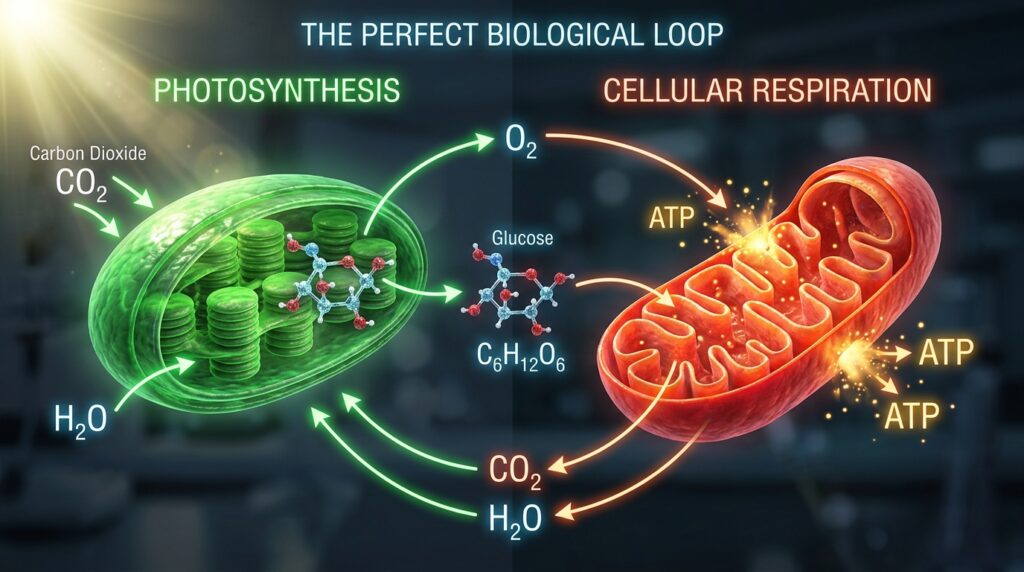
Before we look at the specific machinery inside the cells, we need to understand the big picture. These two processes are direct opposites. What one process builds, the other process breaks apart.
Let’s look at their core chemical equations side-by-side to see the mirror image in action.
The Photosynthesis Recipe (The Baker)
Plants take raw, low-energy ingredients from the environment and use solar energy to bake them into high-energy sugar.
$$\text{Light Energy} + 6\text{CO}_2 \text{ (Carbon Dioxide)} + 6\text{H}_2\text{O} \text{ (Water)} \longrightarrow \text{C}_6\text{H}_{12}\text{O}_6 \text{ (Glucose)} + 6\text{O}_2 \text{ (Oxygen)}$$
The Cellular Respiration Recipe (The Consumer)
Living things take that high-energy sugar, smash it open using oxygen, and harvest the released energy to power their lives.
$$\text{C}_6\text{H}_{12}\text{O}_6 \text{ (Glucose)} + 6\text{O}_2 \text{ (Oxygen)} \longrightarrow 6\text{CO}_2 \text{ (Carbon Dioxide)} + 6\text{H}_2\text{O} \text{ (Water)} + \text{ATP (Energy)}$$
Look closely at the arrows: The outputs (products) of photosynthesis are the exact inputs (reactants) for cellular respiration. The outputs of cellular respiration are the exact inputs for photosynthesis. It is a perfect, self-sustaining loop.
Side-by-Side Comparison: The Quick Guide
When you are reviewing right before an exam or trying to make sense of your study notes, you don’t want to dig through dense paragraphs. Use this high-yield comparison chart to see exactly how these two powerhouses match up.
| Feature / Trait | Photosynthesis | Cellular Respiration |
| The Core Mission | Captures solar energy to store it as chemical sugar (Glucose). | Breaks down sugar to release energy as usable fuel (ATP). |
| Who Does It? | Autotrophs only (Plants, algae, some bacteria). | All living things (Plants, animals, fungi, bacteria). |
| Where in the Cell? | The Chloroplast organelle. | The Mitochondria organelle. |
| The Energy Source | Sunlight. | Chemical bonds in food (Glucose). |
| Gas Taken In | Carbon Dioxide ($\text{CO}_2$). | Oxygen ($\text{O}_2$). |
| Gas Given Off | Oxygen ($\text{O}_2$). | Carbon Dioxide ($\text{CO}_2$). |
| Main Output Product | Glucose ($\text{C}_6\text{H}_{12}\text{O}_6$). | ATP (Adenosine Triphosphate). |
The Stage-by-Stage Breakdown
Both of these processes happen in two main movements, moving molecules around specific structures inside their respective organelles. Let’s trace the journey of energy through both systems.
Inside the Chloroplast (Photosynthesis Stages)
The chloroplast is the plant cell’s solar panel factory. It contains a green pigment called chlorophyll that catches light waves.
1.The Light-Dependent Reactions:Stage 1.
Sunlight hits stacks of green discs inside the chloroplast called thylakoids. The solar energy splits water ($\text{H}_2\text{O}$) molecules open. The cell keeps the hydrogen electrons to charge up its internal molecular batteries (ATP and NADPH) and throws away the oxygen ($\text{O}_2$) into the air as a waste product. This is the oxygen you are breathing right now.
2.The Light-Independent Reactions (Calvin Cycle):Stage 2.
This stage happens in the stroma, the fluid space surrounding the thylakoid discs. It doesn’t need direct light. The cell takes those charged molecular batteries from Stage 1 and uses them to suck carbon dioxide ($\text{CO}_2$) out of the air, gluing the carbon atoms together to forge a stable molecule of glucose sugar.
Inside the Mitochondria (Cellular Respiration Stages)
Once the sugar is made, it needs to be burned for fuel. This happens inside the mitochondria, the engine block of the cell.
1.Glycolysis (The Sugar Split):Stage 1.
This happens outside the power plant, out in the open jelly of the cytoplasm. The cell takes the large 6-carbon glucose molecule and chops it straight in half into two smaller pieces. This quick-and-dirty split generates a tiny burst of 2 ATP energy.
2.The Krebs Cycle (The Carbon Stripper):Stage 2.
The broken pieces of sugar move inside the inner room of the mitochondria, called the matrix. The cell strips away the remaining carbon atoms, releasing them as carbon dioxide ($\text{CO}_2$) gas (which is the carbon dioxide you exhale every time you breathe out). This cycle charges up a massive army of electron carrier batteries (NADH and $\text{FADH}_2$).
3.The Electron Transport Chain (The Massive Payday):Stage 3.
This is where the real power is made. Running along the folded inner walls of the mitochondria (the cristae), the cell uses oxygen ($\text{O}_2$) to pull all those electrons from Stage 2 down a molecular slide. This movement drives an atomic generator that builds a massive payday of 32 to 34 ATP molecules. At the very end of the line, the spent hydrogen joins with oxygen to form pure water ($\text{H}_2\text{O}$).
Mistakes That Can Wreck Your Biology Grade
When you are reviewing your worksheets or taking practice quizzes on platforms like Quizlet, watch out for these three classic trapdoors:
1. The “Plants Don’t Respire” Myth
This is the single biggest point-killer in high school biology. Hundreds of students assume that plants do photosynthesis and animals do cellular respiration, period. That is completely wrong.
Plants make sugar via photosynthesis, but they still have to break that sugar down to stay alive! A plant without cellular respiration is like a chef who bakes a hundred loaves of bread but locks them in a vault until he starves to death. Plants have both chloroplasts and mitochondria; animals only have mitochondria.
2. Swapping the Organelle Locations
Make sure you match the stages to the proper internal real estate.
- Chloroplast: Thylakoids (Light reactions) $\longrightarrow$ Stroma (Calvin Cycle).
- Mitochondria: Cytoplasm (Glycolysis) $\longrightarrow$ Matrix (Krebs Cycle) $\longrightarrow$ Cristae (Electron Transport Chain).Flipping these micro-locations on a diagram is a favorite trick for teachers looking to test your attention to detail.
3. Confusing ATP with Glucose
Remember the difference in intent. Glucose is like a massive $100 bill—it holds a lot of value, but a vending machine won’t accept it. ATP is like a crisp $1 bill. It is the exact denomination of energy your cellular machinery needs to perform a task. Photosynthesis makes the $100 bill (Glucose); cellular respiration breaks it down into pocket change (ATP).
Free Digital Tools to Master the Visuals
If trying to memorize these long strings of carbon atoms on a flat page is making your head spin, step away from the textbook and look at these excellent interactive resources:
- Virtual Biology Lab / PhET Interactive Simulations (University of Colorado Boulder): They have an incredible, free interactive simulation model called “The Greenhouse Effect” and separate molecular labs where you can adjust light intensity and water levels to see exactly how fast a digital plant pumps out oxygen bubbles in real-time. Seeing the dials move makes the causal connection crystal clear.
- Bioman Biology (Respiration & Photosynthesis Games): Features brilliant, free arcade-style browser games like “Respiration Rally” where you pilot a miniature ship through the stages of glycolysis and the electron transport chain, collecting electrons and launching ATP. It is a fantastic way to build visual muscle memory before an exam.
The Big Picture
Biology looks incredibly intimidating when you approach it as an isolated list of vocabulary terms and balancing chemical coefficients. But once you take a step back, you realize it’s just a beautifully synchronized energy exchange.
The chloroplast solar panels catch the sun to lock energy away into a sweet, stable storage molecule. The mitochondrial engines take that molecule, split it open, and turn the lights on inside the cell. Keep that balance sheet in mind, remember that plants run both sides of the engine, and you will navigate your biology tests with total ease.