

I was sitting in the back corner of my 9th-grade English class, staring at a blank prompt on a loose-leaf sheet of paper, feeling a slow, creeping panic. The assignment was simple enough on paper: write an argumentative piece on whether cell phones should be allowed in high school classrooms.
I had plenty of opinions on the topic. The problem wasn’t a lack of ideas—it was that my thoughts felt like a massive, tangled ball of yarn. I started writing whatever popped into my head. I wrote a paragraph about notifications, jumped straight into a story about my middle school principal confiscating a Game Boy, circled back to talking about digital textbooks, and ended it abruptly when I ran out of space on the page.
When my teacher handed it back, it looked like a crime scene. Red ink everywhere. At the bottom, she wrote a note that completely reframed how I view writing: “Your arguments are great, but your reader shouldn’t need a map and a flashlight to find them. Structure gives your ideas power.”
That was my brutal introduction to the classic 5-paragraph essay.
Back then, it felt like an annoying, rigid straightjacket. But as I grew up, went through college, and eventually started writing for a living online, I realized something important: the 5-paragraph format isn’t a trap. It’s a master key. Once you learn the rhythm of this structure, you can use it to build blog posts, script videos, argue a point in a professional email, or crush a timed standardized test without breaking a sweat.
Whether you’re a high school freshman trying to save your English grade, a parent trying to help with homework without losing your temper, or someone who just wants to learn how to organize their thoughts cleanly, let’s break down how to build a perfect 5-paragraph essay step-by-step.
The Blueprint: Visualizing the Structure
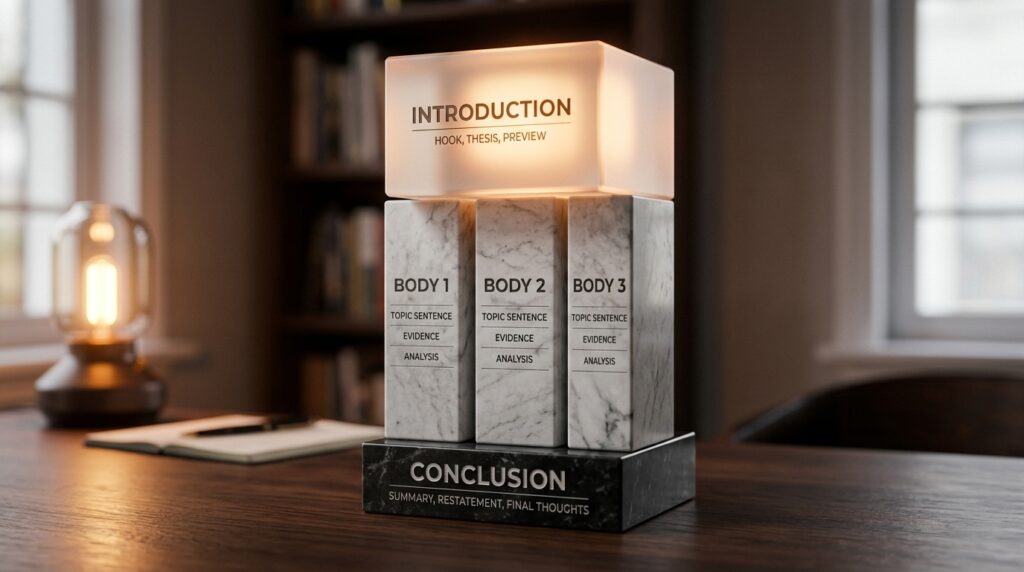
Before you type a single letter into Google Docs, you need to understand the structural architecture. Think of a 5-paragraph essay like a sturdy three-story building.
Plaintext
       [ Introduction ]  <-- The Lobby (Welcomes the reader & states the core claim)
              ||
   [ Body 1 ] [ Body 2 ] [ Body 3 ]  <-- The Pillars (Three distinct supporting arguments)
              ||
       [ Conclusion ]    <-- The Roof (Ties everything together safely)
Every single 5-paragraph essay follows this exact real estate layout:
- Paragraph 1: The Introduction (The map of your essay).
- Paragraph 2: Body Paragraph 1 (Your strongest argument).
- Paragraph 3: Body Paragraph 2 (Your second strongest argument).
- Paragraph 4: Body Paragraph 3 (Your third argument, or a counter-argument).
- Paragraph 5: The Conclusion (The final takeaway).
The Secret Weapon: The Reverse Outline Method
Most people make the mistake of sitting down and trying to write the intro first. They stare at a flashing cursor for twenty minutes trying to write a beautiful opening sentence. It’s an absolute waste of energy.
When I write now, I use a trick called the Reverse Blueprint. I map out my core arguments in a quick, bulleted scratchpad outline before I touch the introduction. Let’s walk through this process using our classic 9th-grade prompt: Should high school students have a four-day school week?
1.Forge Your Core Claim (The Thesis):Step 1.
Decide your stance instantly. No wishy-washy middle ground. Let’s go with: High schools should adopt a four-day week because it improves student mental health, cuts operational costs, and prepares teenagers for real-world scheduling.
2.Brainstorm Your Three Pillars:Step 2.
Look at your thesis. It already has three built-in arguments. Give each one a dedicated bullet point:
- Pillar 1: Mental health and burnout reduction.
- Pillar 2: Financial savings for the school district (bus fuel, electricity, cafeteria food).
- Pillar 3: Developing time-management skills for college and modern hybrid jobs.
3.Gather Your Receipts (Evidence):Step 3.
Under each pillar, jot down a quick note of a fact, statistic, or logical scenario you will use to prove it. Don’t worry about perfect grammar here—just lock down the evidence.
Once you have this raw skeletal outline typed out, your essay is already 50% finished. Now you just have to flesh out the bones.
Paragraph 1: Writing the Introduction
The introduction has one job: draw the reader in, walk them up to your topic, and hand them your core claim. It should always follow the shape of a funnel—starting broad and narrowing down to a sharp point.
1. The Hook (The Bait)
Start with an engaging statement that makes the reader want to keep reading. Avoid generic dictionary definitions like, “According to Merriam-Webster, a school week is…” That is an instant snooze fest. Instead, use a vivid scenario or a surprising reality.
- Casual Hook: Imagine a Monday morning where the alarm goes off, but instead of dragging yourself out of bed in the dark, you get to sleep in, catch up on missing assignments, or finally take a breath.
2. The Bridge (The Context)
Connect your hook to the main debate. Give a sentence or two of background info so the reader understands why this topic matters right now.
- Bridge sentence: Across the country, school districts are facing historic levels of student burnout and rising operational expenses. As a result, administrators are actively debating whether the traditional five-day model is outdated.
3. The Thesis Statement (The Anchor)
This is the single most important sentence in your entire essay. It belongs at the very end of your first paragraph. It is the explicit declaration of your argument and the three points you will use to prove it. Drop your step-by-step blueprint right here.
Paragraphs 2, 3, & 4: Constructing the Body Pillars
Each body paragraph must focus on only one of your supporting pillars. If you start talking about mental health in your financial paragraph, the structure crumbles.
To keep things running smoothly, build every body paragraph using the MEAL plan:
- M — Main Idea: Start with a clean topic sentence that states exactly what the paragraph is about.
- E — Evidence: Provide a quote, a statistic, or a concrete real-world example.
- A — Analysis: Explain why this evidence proves your point. This is your voice—don’t just list a fact and walk away. Explain the connection.
- L — Link: Write a quick closing wrap-up sentence that transitions neatly into the next paragraph.
Example Body Paragraph (Pillar 1: Mental Health)
(Main Idea) First and foremost, a four-day school week drastically improves student mental health by preventing chronic burnout. (Evidence) According to a 2023 study on alternative schooling structures, students enrolled in four-day systems reported a 30% reduction in stress and significantly higher sleep quality over the weekend. (Analysis) High schoolers currently juggle seven classes, hours of nightly homework, and intense extracurricular activities, leaving virtually no time for emotional decompression. An extra day off provides an essential release valve, allowing teenagers to return to class refreshed, focused, and emotionally ready to learn. (Link) This mental rejuvenation directly translates into a more productive school environment, while simultaneously lowering the district’s overhead expenses.
Paragraph 5: Crafting a Natural Conclusion
A lot of old-school writing rubrics will tell you to start your conclusion with “In conclusion” and just restate your thesis word-for-word. Please don’t do that. It sounds robotic, forced, and repetitive.
Instead, think of your conclusion as the mirror image of your introduction. Start narrow (with your thesis) and open back up to the big picture.
- Step 1: Restate your claim with fresh vocabulary. Don’t just copy-paste. Rephrase the main idea so it feels like a victory lap.
- Example: Ultimately, shifting away from the traditional five-day grind is a practical win-win scenario that protects a student’s peace of mind while balancing the school district’s checkbook.
- Step 2: Synthesize, don’t summarize. Briefly remind the reader how your three points look when woven together.
- Step 3: The Final Thought (The Mic Drop). Leave your reader with a compelling final thought or a call to action that lingers in their mind.
- Example: The world of work and education has shifted dramatically over the last decade, and it is time for our school calendars to catch up with reality. Embracing a shorter week isn’t about doing less—it’s about doing things better.
Common Mistakes to Avoid
When you are editing your draft in Google Docs or proofreading a printed copy, actively hunt for these three classic essay killers:
1. The “I Think” Fluff
Avoid using phrases like, “In my opinion,” “I believe,” or “I think.” When you write an argumentative essay, you are the expert.
- Weak: I think the four-day school week is good for saving money.
- Strong: The four-day school week significantly reduces district expenditures. Dropping “I think” instantly makes your writing sound authoritative and convincing.
2. Missing Transitions
If you jump from one paragraph to the next without a transitional phrase, your essay feels incredibly choppy. Use subtle directional signs at the start of your body paragraphs: Furthermore, In addition to financial savings, Conversely, On the other side of the debate.
3. The Novel Idea Trap in the Conclusion
Never introduce a completely brand-new point or a random statistic in your conclusion. If you suddenly remember an awesome argument about school lunches while writing paragraph 5, do not stick it there. Go back and build it into a body paragraph where it can be properly supported with evidence.
Digital Tools to Polish Your Writing
Don’t just rely on your naked eye to edit your work. Leverage these free web tools to catch formatting and structural issues before turning in your final draft:
- Hemingway Editor (Web App): A phenomenal, free browser tool. You paste your essay draft into the editor, and it color-codes your text to show you where sentences are too long, too complex, or hard to read. It is excellent for helping you chop down dense walls of text into punchy, clear paragraphs.
- Grammarly: Great for catching basic comma splices, spelling slip-ups, and passive voice issues that might annoy an English teacher grading a stack of fifty essays.
- Google Docs Outline Tool: Keep the left-hand outline panel open while you write. If your headings look balanced and symmetric, your essay structure is safely intact.
The Takeaway
Writing a 5-paragraph essay isn’t about following a tedious set of rules just to check off a box on a school rubric. It’s about learning how to take a chaotic swarm of thoughts inside your head, filter them through a logical funnel, and present them to the world in a way that is impossible to ignore.
Map out your pillars first, build your body paragraphs like distinct bricks, frame your thesis like an anchor line, and let the structure do the heavy lifting for you. Once you get the rhythm down, the blank page stops being scary.