
I remember standing on a local sports field last summer, watching my younger brother try to film a slow-motion video of a football kickoff for a school media project. He wanted to capture the exact peak of the ball’s arc against the sunset. After about ten failed attempts, he pulled up the footage on his phone, completely frustrated. “It keeps going higher than I think it will, or dropping too fast,” he grumbled. “I can’t predict the timing.”
I laughed and took a look at the clip. “Well, you’re trying to outsmart gravity without a calculator,” I told him. “That ball is traveling in a perfect parabola. If you want to know exactly when it hits its peak or touches the ground, you don’t need a better camera. You need a quadratic equation.”
He looked at me like I had just suggested he do tax forms for fun. But that’s the thing about quadratic equations—they track curves, arches, and trajectories. Anytime you throw a ball, launch a rocket in a video game, or calculate the stopping distance of a car, you are playing inside the rules of a quadratic.
When you first see them on a whiteboard in 9th-grade math, they look like a cruel upgrade from linear equations. Suddenly, there’s an $x^2$ running around, and everything you learned about simple balancing scales feels useless.
If quadratics are currently making your brain short-circuit, let’s clear the smoke. There are three primary ways to solve a quadratic equation, and once you know how to choose the right tool for the job, the mystery evaporates.
What Makes an Equation “Quadratic”?
Before we look at the solutions, we need to know what we are fighting. A linear equation makes a straight line. A quadratic equation makes a U-shaped curve called a parabola.
The universal, standard look for a quadratic equation is:
$$ax^2 + bx + c = 0$$
- The Golden Rule: The letter $a$ cannot be zero. If there is no $x^2$ term, it isn’t a quadratic anymore; it’s just a regular old linear equation.
- The Goal: We want to find the values of $x$ that make the whole equation equal zero. Because it’s a U-shaped curve, it usually crosses the flat X-axis in two places. That means you will almost always get two distinct answers.
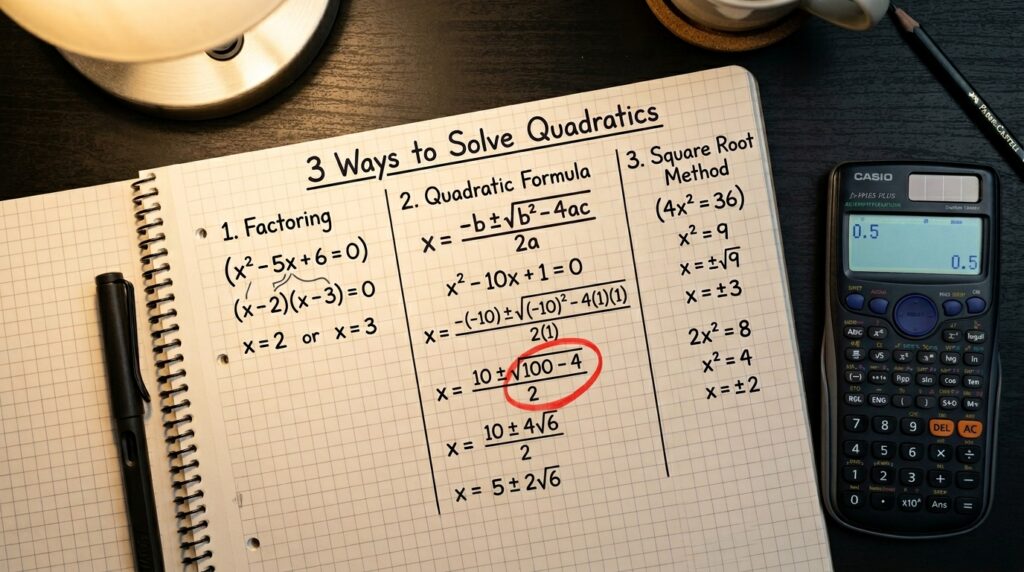
Let’s look at the three easiest ways to break these down.
Method 1: Factoring (The Speed Strategy)
Factoring is like playing a numerical puzzle game. It only works when the numbers play nice, but when they do, it is by far the fastest way to solve a quadratic.
Think of factoring as un-multiplying. We want to turn our messy standard equation back into two clean sets of parentheses.
The Real-World Routine
Let’s solve this equation:
$$x^2 – 5x + 6 = 0$$
Here, our $a = 1$, $b = -5$, and $c = 6$.
When $a$ is 1, the riddle is simple: We need two numbers that multiply to give us $c$ (6) but add up to give us $b$ ($-5$).
Let’s brainstorm factors of 6:
- $2 \cdot 3 = 6$ (But $2 + 3 = 5$, not $-5$)
- $(-2) \cdot (-3) = 6$ (And $-2 + -3 = -5$)
We found them! Our magic numbers are $-2$ and $-3$.
Now we drop them into parentheses:
$$(x – 2)(x – 3) = 0$$
The Zero-Product Property Trick
Now for the easy part. If two things multiplied together equal zero, then at least one of them must be zero. So, we split them into two separate mini-equations:
- Path 1: $x – 2 = 0 \implies x = 2$
- Path 2: $x – 3 = 0 \implies x = 3$
Our answers are $x = 2$ and $x = 3$. If you plug either of those numbers back into the original equation, the whole thing collapses into a perfect zero.
Method 2: The Quadratic Formula (The Tank)
Factoring is great, but real life doesn’t always give you clean integers like 2 and 3. Most of the time, you end up with messy decimals. When factoring fails, you roll out the heavy machinery: The Quadratic Formula.
It looks incredibly intimidating, like a monster from a high-level engineering textbook. But if you look closely, it is just a basic recipe. You pull the numbers out of your equation, drop them into the slots, and follow the order of operations.
$$x = \frac{-b \pm \sqrt{b^2 – 4ac}}{2a}$$
Step-by-Step in Action
Let’s solve this equation using the formula:
$$2x^2 + 5x – 3 = 0$$
First, list your ingredients clearly so you don’t mix them up:
- $a = 2$
- $b = 5$
- $c = -3$
1.Plug in the Ingredients:Step 1.
Substitute your values into the formula slots. Be very careful with the negative signs.
$$x = \frac{-(5) \pm \sqrt{(5)^2 – 4(2)(-3)}}{2(2)}$$
2.Simplify Under the Root:Step 2.
Focus entirely on the math inside the square root first.
- $(5)^2 = 25$
- $-4 \cdot 2 \cdot (-3) = 24$ (A negative times a negative flips to a positive!)Add them together: $25 + 24 = 49$.$$x = \frac{-5 \pm \sqrt{49}}{4}$$
3.Take the Square Root:Step 3.
The square root of 49 is a clean 7.
$$x = \frac{-5 \pm 7}{4}$$
4.Split into Two Paths:Step 4.
Now we handle that $\pm$ sign. It means we run the math twice: once with plus, once with minus.
- The Plus Path: $x = \frac{-5 + 7}{4} = \frac{2}{4} = 0.5$
- The Minus Path: $x = \frac{-5 – 7}{4} = \frac{-12}{4} = -3$
Our final answers are $x = 0.5$ and $x = -3$. The formula works every single time, no matter how ugly the decimals get.
Method 3: The Square Root Property (The Shortcut)
There is a specific type of quadratic equation that people completely overcomplicate. They see it, freak out, and try to use the massive quadratic formula when they could solve it in under ten seconds.
This shortcut works when $b = 0$. In other words, there is an $x^2$ and a plain number, but no middle $x$ term hanging around.
The Real-World Routine
Take a look at this equation:
$$3x^2 – 27 = 0$$
Notice how there is no middle term with just a plain $x$? That means we can solve this using basic balancing operations to isolate the $x^2$.
- Step 1: Move the plain number. Add 27 to both sides.$$3x^2 = 27$$
- Step 2: Get rid of the multiplier. Divide both sides by 3.$$x^2 = 9$$
- Step 3: Take the square root. To undo a square, you take the square root of both sides.$$x = \pm\sqrt{9}$$$$x = \pm3$$
The $\pm$ Trap: Never forget that $(-3) \cdot (-3)$ is also positive 9. Whenever you introduce a square root to solve an equation, you must add that plus-or-minus sign to your answer. Your two solutions are $3$ and $-3$.

Common Mistakes That Ruin Your Math Homework
Over the years, I’ve noticed that people don’t usually fail quadratics because they don’t get the concepts. They fail because of small, structural habits that throw off the calculations.
1. Forgetting to Set the Equation to Zero First
If a problem looks like this: $x^2 – 4x = 12$, you cannot start factoring or using the quadratic formula yet. The standard form requires the equation to equal zero.
Before touching anything else, subtract 12 from both sides to set it up correctly: $x^2 – 4x – 12 = 0$.
2. The Negative Parentheses Disaster
In the quadratic formula, the part that says $-4ac$ trips up everyone when $c$ is a negative number.
If $a=1$ and $c=-5$, the math is $-4 \cdot 1 \cdot (-5)$, which equals positive 20. Thousands of math scores drop every day because people write down a minus sign instead of a plus sign inside that radical.
3. Trusting a Calculator Without Parentheses
If you need to square $-4$ and you type -4^2 into a smartphone calculator or an older Ti-84, it will often output -16. The calculator squares the 4 first, then tacks on the negative. To fix this, always use parentheses: (-4)^2, which properly outputs 16.
Tools to Save Your Sanity
If you are stuck on a problem late at night, don’t just guess. Use these interactive platforms to see what is happening to your equation visually:
- Mathway: You can type in any quadratic equation, select “Solve using the Quadratic Formula,” and it will show you the exact values plugged into their proper places. It’s fantastic for catching sign mistakes.
- Desmos: Type your quadratic equation in as $y = ax^2 + bx + c$. Look at the U-shaped graph it draws. The exact points where that curve touches the horizontal X-axis are your answers. Seeing the link between the algebra and the geometry makes things stick much deeper.
The Takeaway
Quadratic equations aren’t just a hazing ritual for 9th-grade math students. They are the mathematical description of how things move through space when real-world forces are acting on them.
Next time you see one, look at the middle term. If it’s missing, use the Square Root shortcut. If the numbers look clean and simple, try Factoring. If the numbers look horrific, don’t waste time guessing—bring out the Quadratic Formula tank and let the recipe do the work for you.