
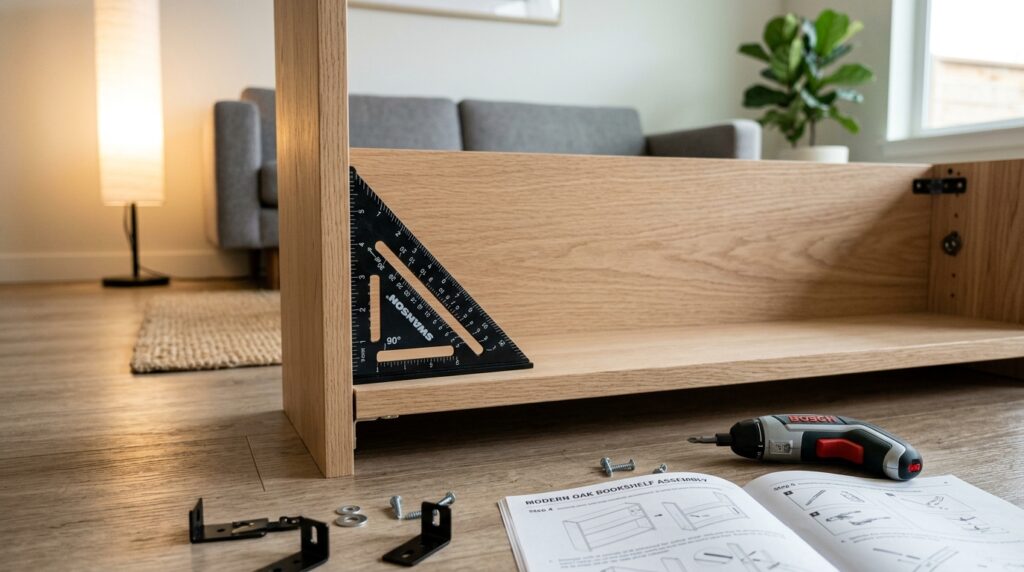
I spent three hours last weekend trying to assemble a minimalist wooden bookshelf I bought online. No big deal, right? Just a few pre-cut boards and some screws. But about halfway through, I noticed something was seriously off. The frame was leaning slightly to the left, and when I tried to slide the back panel into place, it wouldn’t fit into the grooves.
I grabbed an old plastic speed square from my toolbox and pressed it into the corner. Instead of a perfect, flush alignment, there was a glaring gap at the top. The angle wasn’t 90 degrees. It was closer to 93. Because that single corner was slightly off, the entire structural integrity of the shelf collapsed into a crooked mess.
As I sat on my living room floor unscrewing the brackets, I couldn’t help but laugh. It was a brutal, real-world reminder of exactly what my high school geometry teacher used to yell at us about: “Geometry isn’t an abstract puzzle on a chalkboard. It’s the invisible law holding your physical world together!”
If you are a 9th grader currently drowning in a sea of intersecting lines, a parent trying to decipher old math proofs to help with a homework assignment, or just someone looking for a clear, no-nonsense breakdown of how shapes work, let’s make sense of this together. We are going to look at angles, triangles, and the infamous “two-column proofs” using plain, human logic instead of dense textbook academic speak.
1. Angles: The Hidden Corners of Reality
Before you can build complex shapes, you have to understand angles. Think of an angle as the amount of rotation between two straight lines that meet at a single point (the vertex).
Our brains are naturally hardwired to recognize certain types of angles instantly:
- Acute Angles: Small, sharp corners that measure less than 90°. Think of a slice of pizza or the tip of a sharpened pencil.
- Right Angles: The golden standard of engineering. A perfect 90° corner, like the edge of a smartphone screen, a doorway, or a well-built wall.
- Obtuse Angles: Wide, dull corners measuring between 90° and 180°. Think of a reclining lawn chair or a laptop screen pushed back past vertical.
- Straight Angles: A completely flat line measuring exactly 180°.
The Dynamic Duos: Complementary vs. Supplementary
When you start looking at intersecting lines, angles love to hang out in pairs. High school tests love to quiz you on how these pairs interact, and memorizing these two terms will save you tons of points:
$$A + B = 90^\circ \quad \text{(Complementary Angles)}$$
If two angles add up to a clean 90° right angle, they are complementary. Imagine a corner cabinet layout where two angled shelves have to fit perfectly into a corner.
$$A + B = 180^\circ \quad \text{(Supplementary Angles)}$$
If two angles sit on a straight line together, they must add up to 180° to create that flat surface. They are supplementary.
A Quick Trick to Remember Them: Think of alphabetical order. C comes before S, and 90 comes before 180. So, Complementary is 90°, and Supplementary is 180°. Simple as that.
2. Triangles: The Strongest Shapes in Existence
There is a reason why construction cranes, bridge frames, and roof rafters are all made out of interlocking triangles instead of squares. A square can easily skew into a parallelogram if you push hard enough on its corners. But a triangle? To alter its shape, you physically have to break one of its sides. It is structural perfection.
The absolute, unbendable rule of every single triangle on a flat sheet of paper is the Interior Angles Theorem:
$$\text{Angle } A + \text{Angle } B + \text{Angle } C = 180^\circ$$
It doesn’t matter if the triangle is microscopic or the size of a continent; if you add up all three inside corners, you will always get exactly 180°.
Sorting the Triangle Family
You will see triangles grouped by their side lengths and their angle sizes. Here is how to keep them straight:
| Triangle Type | What Makes It Special | Real-World Visual |
| Equilateral | All three sides are identical; all three angles are a perfect 60°. | A classic yellow yield traffic sign. |
| Isosceles | Two sides are equal, and the two bottom angles opposite them match. | The front profile of a classic A-frame cabin roof. |
| Scalene | Total chaos. Every side is a different length, and every angle is unique. | A random, jagged jagged piece of broken glass. |
| Right Triangle | Features one perfect 90° angle. Dictated by the famous Pythagorean theorem. | A standard construction draft square or a ramp. |
3. Demystifying Two-Column Proofs
Let’s address the elephant in the classroom. Mentioning “two-column proofs” to a room full of high schoolers is a surefire way to cause collective groans.
When I first encountered them in 9th grade, I absolutely hated them. I felt like the teacher wanted me to write a formal legal brief for something that was completely obvious just by looking at the picture.
But over the years, I realized that a geometric proof is just a logical argument written down line-by-line. It’s like a software developer debugging a script or a lawyer building a case in court. You can’t just say, “Well, the line looks equal to that one.” You have to state what you know, and then provide the receipt (the rule, theorem, or definition) that proves it.
Plaintext
       Statements             |          Reasons
------------------------------|-------------------------------
 1. What you claim is true    | 1. The official math rule/law
The Big Four Congruence Shortcuts
Most triangle proofs want you to prove that two triangles are completely identical triplets (congruent). Instead of proving all three sides and all three angles match individually, you can use these incredibly helpful shortcuts:
- SSS (Side-Side-Side): If all three sides of one triangle match all three sides of another, they are identical.
- SAS (Side-Angle-Side): If two sides and the angle tucked right between them match, the triangles are locked into the same shape.
- ASA (Angle-Side-Angle): If two angles and the side running between them match, they are congruent.
- AAS (Angle-Angle-Side): If two consecutive angles and a subsequent side match, they are identical.
A Real Step-by-Step Proof Breakdown
Let’s walk through an actual two-column proof problem together so you can see the rhythm of how they work.
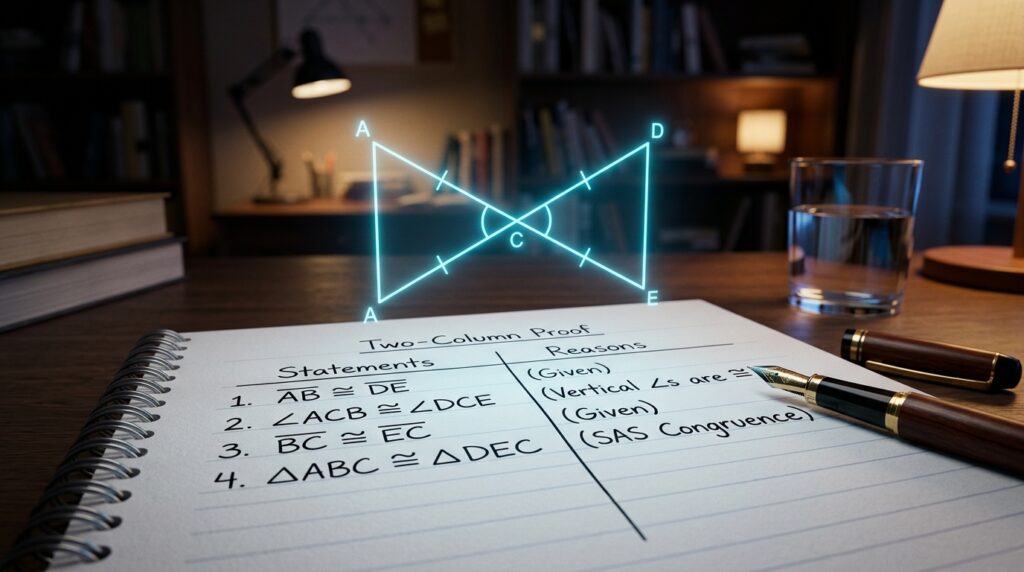
The Setup: Imagine we have a geometric shape that looks like a classic bowtie, formed by two triangles touching at a central vertex point. Let’s call the triangles $\triangle ABC$ and $\triangle DEC$.
Given Information:
- Point $C$ is the exact midpoint of the line segment $AD$.
- Segment $BC$ is equal in length to segment $EC$.
Goal: Prove that triangle $\triangle ABC$ is completely identical (congruent) to triangle $\triangle DEC$.
1.Write Down the Givens:Step 1.
Always start by listing what the problem explicitly hands you on a silver platter. It’s a free point on a test.
- Statement: Point $C$ is the midpoint of $AD$; $BC = EC$.
- Reason: Given.
2.Interpret the Definitions:Step 2.
Look at your first statement. What does a “midpoint” actually do? It slices a line perfectly in half. That means segment $AC$ must equal segment $DC$.
- Statement: $AC = DC$.
- Reason: Definition of a midpoint.
3.Look for Hidden Clues (Vertical Angles):Step 3.
Look closely at the center of the bowtie where the lines cross. Whenever two lines intersect to form an ‘X’, the opposite angles are identical mirror images. These are called vertical angles.
- Statement: $\angle ACB = \angle DCE$.
- Reason: Vertical angles are congruent.
4.Make the Final Claim:Step 4.
Look at the clues we have accumulated: we have a matching Side ($AC=DC$), a matching Angle ($\angle ACB=\angle DCE$), and another matching Side ($BC=EC$). The angle is perfectly cradled between the sides. We have found our shortcut!
- Statement: $\triangle ABC \cong \triangle DEC$.
- Reason: SAS Congruence Postulate.
Common Mistakes to Watch Out For
Geometry tests are unique because they don’t just measure your ability to add and subtract; they test your attention to detail. Here are the three most frequent traps students fall into:
1. Falling for the “Visual Mirage”
Never assume two lines are parallel or equal just because they look like it on the printed paper. Textbook creators purposely draw diagrams slightly distorted to trick students who aren’t reading the actual text clues. Unless you see matching tick marks on the lines, or a little square icon in a corner indicating a 90° angle, do not treat it as a fact!
2. Confusing SAS with SSA
The ordering of letters in your congruence shortcuts matters immensely. In SAS, the matching angle must be tucked neatly between the two matching sides. If the matching angle is off to the side somewhere else (forming Side-Side-Angle), it does not prove the triangles are identical.
3. Mixing up Complementary and Supplementary
We touched on this earlier, but flipping these two terms is the number one cause of lost points on early geometry quizzes. Take an extra half-second during a test to look at your definitions before doing your arithmetic.
Real Tools to Make Geometry Click Visually
If trying to draw these shapes on static graph paper is making you cross-eyed, drop the pencil and try out these excellent interactive web apps:
- GeoGebra Geometry: A phenomenal, completely free web application. You can physically drop coordinate points on a digital canvas, draw lines, snap triangles together, and alter their shapes in real-time. It displays the precise measurements of angles and side lengths instantly as you drag them around, turning abstract rules into something tangible.
- Euclidea: A fantastic mobile puzzle game available on iOS and Android. It turns geometric constructions (like bisecting an angle using only a virtual compass and straightedge) into a progressive video game format. It is addicting and builds incredible spatial intuition.
Keeping It Simple
Geometry can feel incredibly overwhelming when you view it as a massive wall of definitions, postulates, and proofs to memorize. But if you take a step back, it’s really just a toolkit for analyzing patterns and structure.
Keep your eye out for matching tick marks, remember the absolute rule of the 180° triangle, and approach your proofs like a logical investigator building a case. Once you see the rules governing the shapes, your perspective shifts—whether you are tackling a tough math exam or just trying to assemble a stubborn piece of living room furniture.