
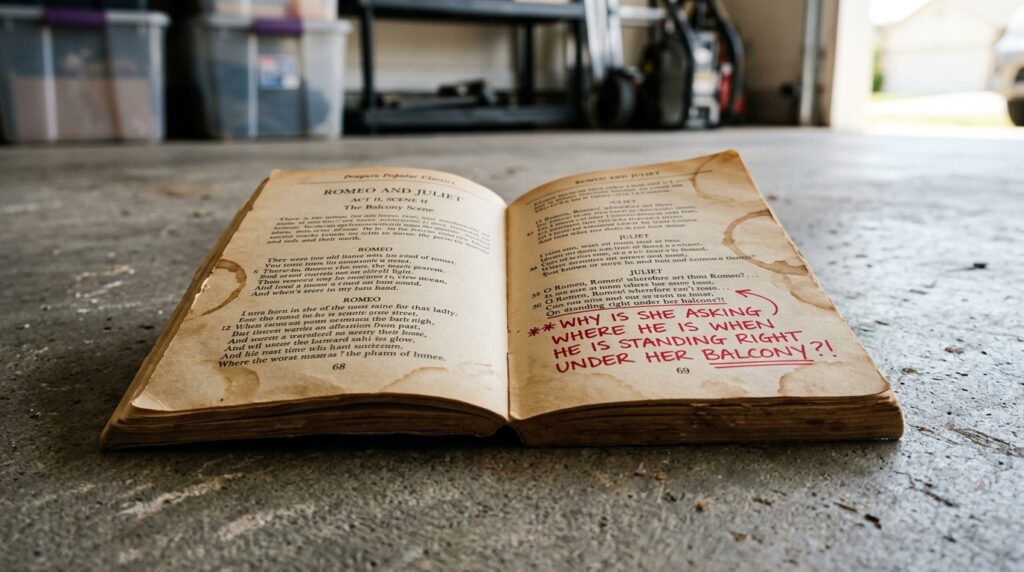
I was helping my younger sister clear out a stack of old textbooks from our garage last spring when a beat-up, paperback copy of Shakespeare’s Romeo and Juliet dropped onto the concrete. The cover was completely torn, and the pages were stained with dried coffee.
I picked it up, flipped it open, and burst out laughing when I saw my own 9th-grade handwriting scribbled all over the margins of Act 2, Scene 2. Next to Juliet’s famous line, “O Romeo, Romeo! wherefore art thou Romeo?” I had written a massive, frustrated note in red ink: “WHY IS SHE ASKING WHERE HE IS WHEN HE IS STANDING RIGHT UNDER HER BALCONY?!”
It was a classic freshman mistake. I didn’t realize back then that “wherefore” doesn’t mean where—it means why. She wasn’t looking for his physical location; she was asking why his name had to be Romeo, the son of her family’s ultimate enemy.
Trying to read Shakespeare for the first time feels like trying to read a software script written in a corrupted programming language. The words look like English, but the rhythm, the old-school slang, and the dense metaphors make your brain want to shut down.
But once you strip away the intimidating Elizabethan theater packaging, you realize that Romeo and Juliet isn’t a boring museum piece. It’s a fast-paced, chaotic story about street gangs, terrible communication, impulsive choices, and teenagers making permanent decisions based on temporary feelings.
Whether you are a 9th grader trying to survive an upcoming English essay, a parent trying to decipher old play acts to help with homework, or someone looking for a clear refresher, let’s break down the plot, the core themes, and the crucial quotes using plain, modern language.
The Plot: A 90-Second Crash Course
To understand the specific scenes on your English quizzes, you need to know the basic timeline of the play. The most shocking thing people forget about Romeo and Juliet is how fast it happens. The entire story takes place over just five chaotic days.
Plaintext
[Sunday] Masquerade Party Premonition ──> [Monday] Secret Wedding & Street Brawl ──> [Tuesday] Exile & The Potion Plan ──> [Wednesday/Thursday] The Crypt Tragedy
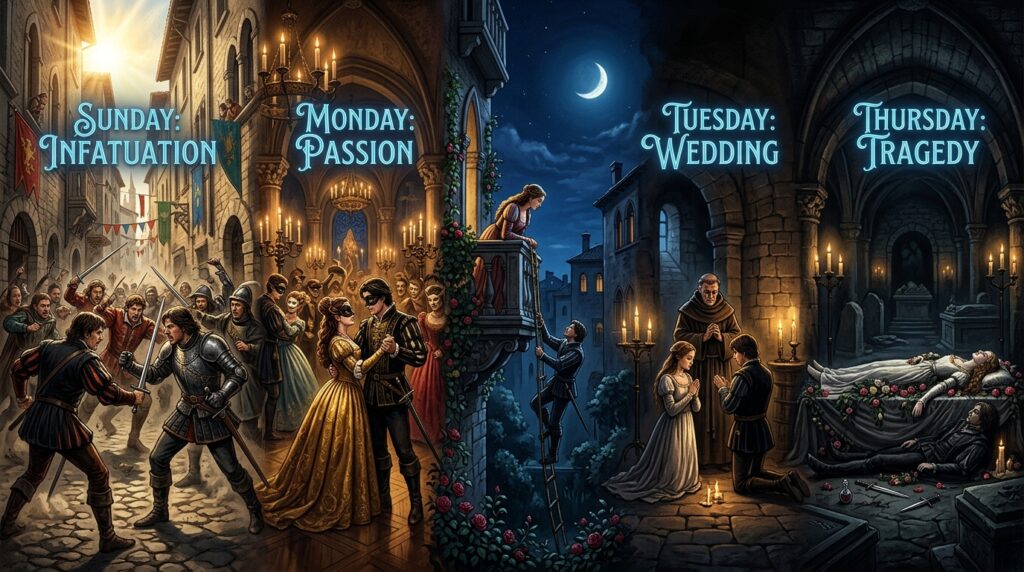
- Sunday: A massive street fight breaks out in Verona between two wealthy families who hate each other: the Capulets and the Montagues. Later that night, Romeo (a Montague) crashes a Capulet masquerade party to creep on a different girl, but meets Juliet (a Capulet) instead. Instant sparks fly. They meet at Juliet’s balcony later that night and promise to get married.
- Monday: Friar Laurence marries them in secret, hoping their love will end the family war. An hour later, Juliet’s cousin, Tybalt, picks a fight with Romeo. Romeo refuses to fight his new secret relative, so Romeo’s best friend, Mercutio, steps in and gets killed by Tybalt. Blinded by rage, Romeo kills Tybalt and gets permanently banished from the city of Verona.
- Tuesday to Thursday: Juliet’s dad tries to force her to marry a random count named Paris. To escape, Juliet drinks a sleeping potion from Friar Laurence that makes her look completely dead for 42 hours. The plan is for Romeo to rescue her from the family tomb when she wakes up.
- The Breakdown: The messenger sent to tell Romeo about the fake-death plan gets quarantined due to a plague outbreak and never delivers the letter. Romeo hears from a random friend that Juliet is dead, buys actual poison, runs to her tomb, drinks it, and dies. Seconds later, Juliet wakes up, sees Romeo’s body, grabs his dagger, and kills herself.
The Core Themes: What Your Teacher Actually Cares About
When you write an essay or take a unit test, your teacher doesn’t just want you to repeat the plot. They want to see if you can track the deeper patterns running through the script. Here are the three pillars you should focus on.
1. The Danger of Impulsivity vs. Moderation
Almost every bad thing that happens in this play is caused by speed. The characters don’t think; they react. Friar Laurence explicitly warns Romeo about this early on, stating, “Wisely and slow; they stumble that run fast.” The lovers go from strangers to a married couple in under 24 hours, and their friends jump into lethal sword fights over simple insults. Shakespeare is showing us what happens when raw emotion completely overwrites logical maturity.
2. Fate and the Illusion of Control
From the literal first paragraph of the play, the audience is told that these two are “star-crossed lovers” who are destined to destroy themselves. No matter how hard Friar Laurence plans, or how hard Romeo tries to avoid fighting, minor accidents (like a botched letter delivery or a plague quarantine) derail everything. The play asks a brilliant question: are we in control of our own lives, or are we just passengers to bad luck?
3. Individual Identity vs. Family Duty
Both Romeo and Juliet are trapped inside names they didn’t choose. To the city of Verona, they aren’t unique individuals; they are foot soldiers for the Capulet and Montague brands. Juliet’s entire balcony soliloquy is a desperate attempt to separate the guy she loves from the family crest he wears.
Key Quotes Decoded for English Essays
If you want to get full points on a literature essay, you have to drop real quotes into your body paragraphs and explain how they work. Let’s look at the three most heavily tested quotes in the play and decode what they mean in plain English.
Quote 1: The Brand Dilemma
“O Romeo, Romeo! wherefore art thou Romeo? / Deny thy father and refuse thy name; / Or, if thou wilt not, be but sworn my love, / And I’ll no longer be a Capulet.” — Juliet (Act 2, Scene 2)
- The Context: Juliet is talking to herself out loud on her balcony, completely unaware that Romeo is hiding in the bushes below listening to her.
- The Real Meaning: As we covered earlier, she is asking, “Why does the guy I like have to be a Montague?” She is begging him to ditch his family identity so they can be together, or promising that if he won’t do it, she will leave her own family behind for him. It directly highlights the theme of Individual Identity vs. Family Duty.
Quote 2: The Bitter Curse
“A plague o’ both your houses! / They have made worms’ meat of me.” — Mercutio (Act 3, Scene 1)
- The Context: Mercutio has just been stabbed under Romeo’s arm during the street fight with Tybalt. He knows he is dying on the street.
- The Real Meaning: Mercutio isn’t a Capulet or a Montague; he’s caught in the crossfire of someone else’s stupid family war. As he dies, he loses all his playful wit and curses both families for their senseless hatred. The phrase “worms’ meat” is a vivid, grim reminder of mortality—he’s realizing his life is over just to protect family pride.
Quote 3: The Dangerous Inevitability
“I fear, too early: for my mind misgives / Some consequence yet hanging in the stars / Shall bitterly begin his fearful date / With this night’s revels…” — Romeo (Act 1, Scene 4)
- The Context: Romeo is standing outside the Capulet mansion right before crashing the masquerade party. He has a sudden feeling of dread.
- The Real Meaning: This is a classic example of foreshadowing. Romeo has a premonition that going to this party is going to set off a chain reaction of dark events “hanging in the stars” that will end in his own death. Even though he feels the danger, he walks through the front door anyway, stepping directly into his fate.
Classic Mistakes to Avoid on Quizzes
When you’re studying your character guides or completing worksheets, make sure you don’t fall into these common interpretations traps:
- Thinking It’s a Pure, Romantic Love Story: Modern pop culture treats Romeo and Juliet like the ultimate valentine. But Shakespeare actually wrote it as a cautionary tale about extreme, obsessive infatuation. If your essay claims their love was perfect and beautiful, you’re missing the point. It was reckless, intense, and left six young people dead in less than a week.
- Misunderstanding “Wherefore”: I will say it one more time because it shows up on almost every freshman vocabulary quiz: wherefore means why, not where.
- Confusing Tybalt and Benvolio: These are the two primary opposing forces surrounding Romeo. Tybalt is a Capulet who is obsessed with honor, hot-headed, and looking for a fight at all times. Benvolio is a Montague (Romeo’s cousin) whose entire personality is centered around keeping the peace and calming situations down.
Free Digital Tools to Help You Study
If reading the original Old English text makes your eyes cross, do not just give up and read a sketchy online summary site. Use these free platforms to read the play interactively:
- No Fear Shakespeare (by SparkNotes): An absolute lifesaver tool. It displays the original Shakespearean script on the left side of the screen and a line-by-line modern translation on the right side. Use it to understand the literal plot mechanics, but make sure you pull original quotes from the left side for your actual essay papers.
- MyShakespeare.com: An exceptional, free interactive digital textbook. It features the full text of the play alongside quick cartoon animations, video breakdowns of complex metaphors, and audio recordings of professional actors performing the lines. It makes the audio-visual pacing of the play come alive.
The Final Takeaway
- Romeo and Juliet looks incredibly intimidating because we approach it like a chore to be graded rather than a performance to be watched.
- Strip away the 400-year-old dialect barriers, and you are left with a modern, high-yield story about the intense weight of family expectations and the explosive velocity of teenage emotion.
Keep your character connections straight, watch your thematic vocabulary terms like impulsivity and foreshadowing, and you will cruise through your 9th-grade English unit with complete ease.