
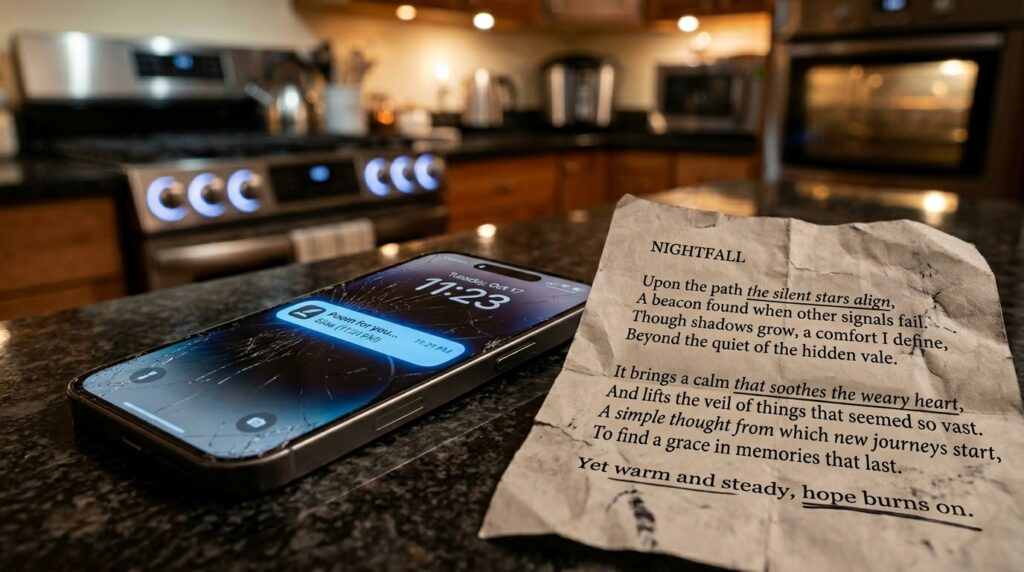
I was standing in the kitchen last night, trying to figure out why my smartphone’s screen wouldn’t turn on after a minor drop, when my younger brother burst through the front door. He looked completely defeated, holding a printout of a poem for his 9th-grade honors English class.
He dropped it onto the counter and groaned, “My teacher wants me to find three hidden meanings using ‘literary devices.’ I don’t get it. Why can’t writers just say exactly what they mean? Why does a stormy night have to mean the main character is sad? Why can’t a stormy night just be bad weather?”
I looked down at my broken phone. “Well,” I said, “think about the notification sound your phone makes when you get a text. It’s just a digital beep. But when you hear it, your brain instantly translates it into anticipation, stress, or excitement depending on who is messaging you. The beep is a shortcut for an entire emotional landscape. Writers use literary devices the exact same way. They are just code shortcuts for human emotion.”
When you look at a textbook glossary, literary devices read like a laundry list of complicated Greek roots: onomatopoeia, synecdoche, metonymy, anaphora. It feels like trying to learn an ancient dialect just to read a short story.
But once you realize that you already use these devices every single day when talking to your friends, posting online, or watching movies, the intimidation evaporates. They are simply tools to make words carry more weight.
Whether you’re a high school freshman trying to save your English grade before midterms, a parent playing homework coach, or someone who wants to sharpen their own writing voice, let’s break down the essential literary devices simply, with real examples you will actually remember.
The Master List: 12 Key Devices Decoded
Let’s go through the absolute heaviest-hitting literary devices that show up on 9th-grade unit exams. We’ll skip the textbook definitions and focus on how they actually operate.
1. Simile
Comparing two entirely different things using the words “like” or “as.” It forces the reader’s brain to instantly overlay the traits of one object onto another.
- Real-World Example: “My laptop is running as slow as a wet week.”
- The Blueprint: You are taking the frustration of a miserable, dragged-out week and applying it to a lagging processor.
2. Metaphor
Comparing two things without using “like” or “as.” Instead of saying something is similar to a trait, you boldly state that it is that trait. It is a much more aggressive, powerful device than a simile.
- Real-World Example: “That final exam was a absolute minefield.”
- The Blueprint: Obviously, there were no physical explosives in the classroom. But by calling it a minefield, you communicate that one wrong step or careless answer would completely blow up your grade.
3. Personification
Giving human traits, emotions, or actions to non-human things like objects, animals, or weather patterns.
- Real-World Example: “My alarm clock screamed at me to wake up at 6:00 AM.”
- The Blueprint: Alarm clocks don’t have vocal cords or emotions. But by describing its ring as a scream, you capture the harsh, aggressive reality of waking up early.
4. Hyperbole
Massive, intentional exaggeration used to make a point or create a dramatic effect. It is never meant to be taken literally.
- Real-World Example: “I have a million hours of homework to finish before tomorrow.”
- The Blueprint: Even if you stayed up all night, a million hours is mathematically impossible. But it perfectly captures the crushing weight of a heavy school workload.
5. Onomatopoeia
Words that physically sound like the noise they are describing. When you say the word out loud, it mimics the action.
- Real-World Example: The buzz of the broken fluorescent light, the clack of the mechanical keyboard, or the sudden pop of a balloon.
6. Imagery
Using incredibly descriptive words that appeal directly to the five senses (sight, sound, smell, taste, touch). It creates a vivid mental movie for the reader instead of a flat description.
- Flat Description: “The cafeteria food was bad.”
- Sensory Imagery: “The tepid, grey mystery meat slathered in a congealed, salty gravy emitted a pungent stench that turned my stomach.”
7. Alliteration
Repeating the same starting consonant sound in a group of words that sit close together. It creates a specific rhythm or musical flow when read aloud.
- Real-World Example: Silently scrolling through social media subreddits.
8. Irony
When the reality of a situation is the exact opposite of what you logically expect to happen. There are three types you need to know for quizzes:
- Situational Irony: A fire station burning down, or a professional social media manager losing their password.
- Verbal Irony: Stepping outside into a freezing, miserable downpour and saying, “Wow, beautiful weather we’re having today!” (Basically, sarcasm).
- Dramatic Irony: When the audience or reader knows a massive secret that the main characters are completely blind to (like knowing Romeo thinks Juliet is dead, but we know she’s just asleep).
9. Foreshadowing
Dropping subtle, sneaky clues early in a story that hint at a massive plot twist or event that will happen later on. It builds tension.
- Real-World Example: A character casually complaining about a persistent cough in chapter one, hinting that they will fall severely ill by chapter ten.
10. Allusion
A passing reference to a famous person, place, historical event, book, or movie that the writer assumes the reader will instantly recognize. It saves the writer from having to explain a concept from scratch.
- Real-World Example: “Don’t look at me like that, I’m no Romeo.”
- The Blueprint: By using the name Romeo, you instantly reference the ultimate historical symbol of obsessive, romantic infatuation without having to write three paragraphs explaining it.
11. Oxymoron
Placing two completely contradictory words right next to each other to create a striking, confusing, or deep paradox.
- Real-World Examples: Deafening silence, seriously funny, ordered chaos, or living dead.
12. Symbolism
When a physical object, a color, or a character represents a massive, abstract idea that goes way deeper than its literal definition.
- Real-World Example: A simple green traffic light in a novel representing hope and a drive toward the future, or a raven representing incoming death and grief.
Quick Reference: The Snapshot Matrix
When you need to review right before your teacher starts passing out an exam paper, use this quick cheat sheet matrix to test your memory.
| Device Name | The Cheat Shortcut | Real-World Anchor Example |
| Simile | Comparison using Like or As | “Quiet as a mouse.” |
| Metaphor | Direct comparison (Is comparison) | “Time is money.” |
| Personification | Object acts human | “The wind howled.” |
| Hyperbole | Massive exaggeration | “This bag weighs a ton.” |
| Alliteration | Matching starting sounds | “Click bait culture.” |
| Oxymoron | Opposite words paired up | “Bittersweet victory.” |
| Allusion | Historical / Cultural shoutout | “He’s a real Einstein.” |
Step-by-Step: How to Analyze Any Text
When an English prompt tells you to “analyze the literary devices” in a passage, don’t just guess or underline random adjectives. Use this simple, three-step execution framework to build an A-grade paragraph.
1.The Scan & Highlight Phase:Step 1.
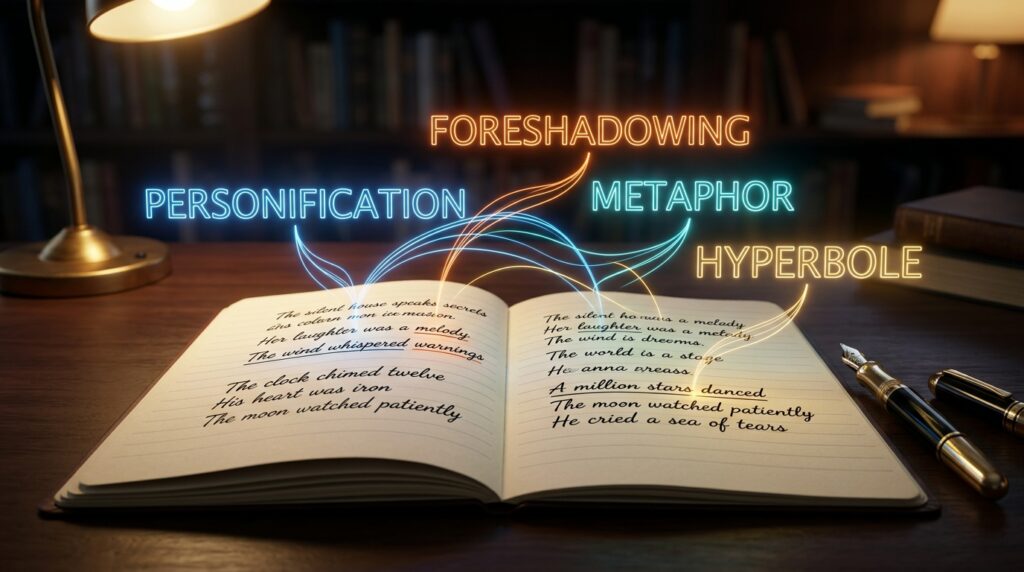
Read the passage completely once just to understand the literal plot. On your second read, look for anomalies. Highlight any phrases that don’t mean what they literally say—look for comparisons, weird word pairings, or vivid sensory words.
2.The Labeling Phase:Step 2.
Name the tool. Use your checklist to identify the exact device. If it uses “like,” label it a simile. If an object is acting alive, label it personification.
3.The:Step 3.
This is where most students lose points. Do not just say, “The author uses a metaphor here.” Explain why they chose that specific tool. How does it change the mood? What does it make the reader feel? If you can answer the “so what?”, your analysis is bulletproof.
Common Pitfalls to Avoid on Literature Exams
When completing study guides or drafting essays, make a mental note to dodge these three classic traps:
1. The Simile vs. Metaphor Mix-up
This is the single most common cause of lost points on freshman vocabulary quizzes. Students see any comparison and automatically label it a metaphor. Take an extra half-second to hunt for the structural tell-tale words: if like or as are present, it is strictly a simile.
2. Assuming Every Symbol is Intentional
Sometimes a blue curtain is just a blue curtain. Don’t over-analyze every single noun in a short story trying to find a deep, cosmic meaning. Look for repetition—if an author mentions a specific object three or four times across different scenes, then it is likely a deliberate symbol.
3. Confusing Alliteration with Assonance
Alliteration requires the starting consonant sounds to match. If the vowel sounds inside the middle of the words match (like “go slow on the road”), that is a completely different device called assonance. Don’t swap them on a multiple-choice section.
Free Digital Tools to Polish Your Analytical Skills
If staring at old black-and-white printouts is making your head spin, leverage these excellent free interactive platforms to study:
- Quizlet: Search for “9th Grade Literary Devices Identification.” There are thousands of community-built flashcard sets containing interactive matching games that test your ability to spot devices using modern pop-culture song lyrics or movie quotes. It makes pattern recognition effortless.
- No Fear Literature / LitCharts: Exceptional platforms for analyzing assigned class novels (like The Odyssey or To Kill a Mockingbird). They break down chapters line-by-line, showing you exactly where the author deployed symbolism, foreshadowing, or irony, helping you check your own analytical accuracy.
The Takeaway
Literary devices aren’t just an arbitrary list of academic vocabulary terms designed to make reading more tedious. They are the underlying programming language of human expression. They allow a writer to transmit complex, abstract emotions directly into your brain using structural shortcuts you already understand.
Keep your matrix shortcuts handy, analyze text methodically by always asking “so what?”, and you will navigate your 9th-grade literature units with total ease.