
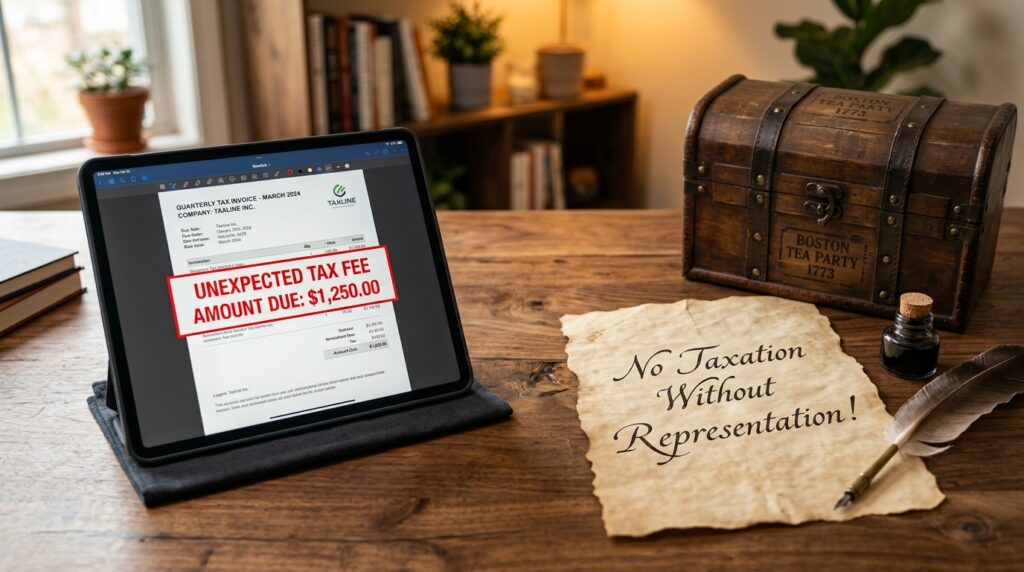
My monthly cell phone bill arrived in my email inbox a few weeks ago, and when I opened the PDF, my jaw hit the floor. My total was almost 25% higher than usual. When I combed through the itemized breakdown, I found a sneaky, mandatory “regional infrastructure service fee” that my carrier had tacked on without warning.
I was furious. I immediately jumped on their customer support live chat, typing at a million miles an hour, demanding to know why I was being forced to pay for a service upgrade that I never signed up for, never voted on, and had no say in.
While I was aggressively debating a digital customer service bot over a twelve-dollar fee, my younger cousin sat across from me at the kitchen table. He was drowning in a stack of flashcards, trying to memorize a massive timeline for his 9th-grade World History midterm.
He looked at my angry face, looked down at his notes, and laughed. “Hey, look on the bright side,” he said. “You finally understand exactly how the American colonists felt in 1773.”
He pointed to a flashcard that read: The Boston Tea Party.
He was totally right. When you open a high school history textbook, the American Revolution looks like a boring, dry catalog of oil paintings, dusty declarations, and guys in white wigs marching in perfect rows. It feels completely disconnected from real life.
But once you strip away the heavy academic gatekeeping, the American Revolution is just a massive, high-stakes story about a group of people who got hit with unfair, surprise bills from a distant authority, reached their absolute breaking point, and decided to build a completely new system from scratch.
Whether you are a 9th grader trying to pass a brutal unit exam, a parent trying to make sense of old war maps for homework duty, or someone looking for a clear, straightforward refresher, let’s look at the actual sparks that started the fire, the key turning points, and the massive ripples it left behind.
The Spark: Unfair Bills and Broken Rules
To understand why the colonies exploded into war, you have to look at the history like a messy business breakup. For over a hundred years, Great Britain basically left the thirteen American colonies alone. The colonists ran their own local governments, set their own local rules, and got used to an incredible amount of freedom.
Then came the French and Indian War. Britain won the war and protected the colonies, but the victory left the British government completely broke. They needed cash fast, so they looked across the Atlantic Ocean and decided it was time for the colonists to pay up.
The Surprise Fees
Britain started dropping a sequence of unexpected tax acts onto the colonies, and each one felt like a worse cell phone bill than the last:
- The Stamp Act (1765): A surprise tax on every single piece of printed paper the colonists used—legal documents, newspapers, playing cards, and even diplomas. Imagine having to pay a digital fee every single time you downloaded a PDF or printed a homework assignment.
- The Townshend Acts (1767): Taxes on everyday imported essentials like glass, lead, paint, paper, and tea.
- The Tea Act (1773): A law that gave a monopoly to the British East India Company, undercutting local colonial merchants and controlling the tea trade completely.
The Real Problem: No Representation
Here is the classic mistake people make on history quizzes: The colonists weren’t actually mad about the money. The taxes themselves were actually pretty small.
What made them furious was the process. Under British law, citizens could only be taxed if their elected representatives voted on it. The colonists had zero seats in the British Parliament.
They were being forced to pay bills without getting a voice in the room. This birthed the ultimate protest slogan that you will see on every single history test: “No taxation without representation!”
The Crucial Timeline: From Protests to Full War
The tension didn’t turn into a war overnight. It was a slow, agonizing escalation over a decade. Let’s look at the chronological sequence of events that pushed the colonies over the edge.
The Boston Massacre
March 5, 1770
A tense standoff between a mob of angry colonists and a squad of British soldiers in the streets of Boston turns lethal. Shots are fired into the crowd, leaving five colonists dead. Local leaders use the event as a massive propaganda tool to show British cruelty.
The Boston Tea Party
December 16, 1773
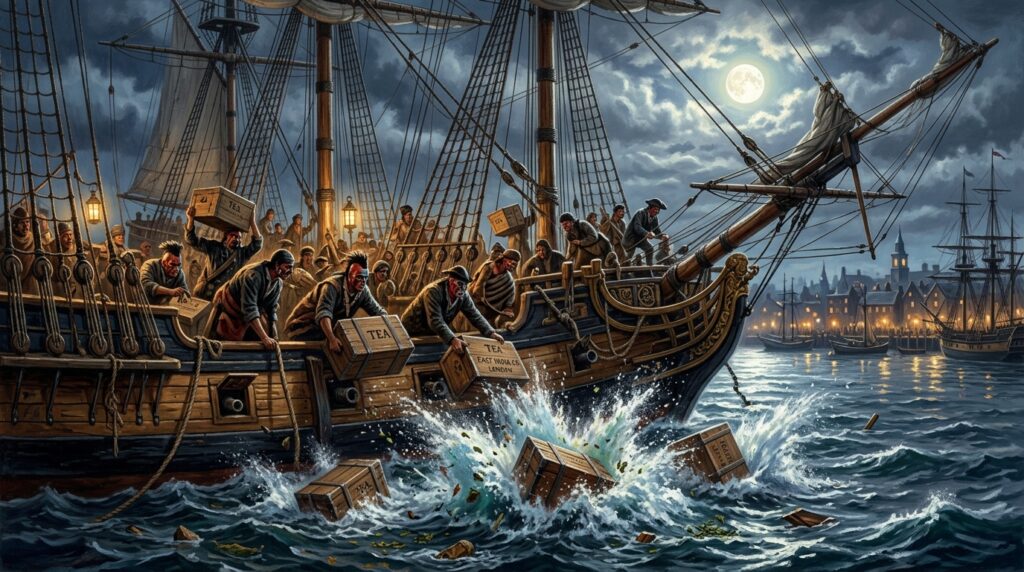
A group of protestors called the Sons of Liberty disguise themselves, board three British merchant ships in the middle of the night, and dump 342 chests of valuable tea directly into Boston Harbor. It causes millions of dollars in modern financial damage.
The Intolerable Acts
Spring 1774
An angry King George III decides to punish Boston by passing a series of brutal laws. He shuts down Boston Harbor completely, bans town meetings, and forces citizens to house British soldiers in their private homes (The Quartering Act). This backfires by uniting all thirteen separate colonies against Britain.
Lexington & Concord
April 19, 1775
The breaking point. British troops march toward Concord, Massachusetts to confiscate a secret colonial weapons cache. Armed local militia farmers intercept them. An unknown person fires a shot—known as “The Shot Heard ‘Round the World”—and an open war officially begins.
The Declaration of Independence
July 4, 1776
The colonies officially file for divorce. Written primarily by Thomas Jefferson using ideas from Enlightenment philosophies, this document states that all humans have natural rights and that the colonies are now a free, independent nation called the United States.
The Turning Points: How an Underdog Won
On paper, the Americans should have lost the war within six months. The British army was the most powerful, well-trained, and well-funded military force on the planet. The American continental army was a ragtag collection of local farmers, blacksmiths, and teenagers who didn’t even have matching uniforms.
When you are writing an essay or preparing for a presentation on how the Americans managed to pull off the ultimate upset, focus on these three critical turning points:
| Milestone Event | What Happened? | Why It Changed the War |
| The Battle of Saratoga (1777) | American forces trap and defeat a major British army in New York. | This was the ultimate turning point because it proved to the rest of the world that the Americans actually had a chance. Seeing this win, France officially entered the war as an American ally, sending vital ships, troops, and money. |
| Winter at Valley Forge (1777-1778) | Washington’s army survives a brutal, freezing winter with minimal food, shoes, or blankets. | Instead of quitting, the soldiers used the winter to undergo an intense military bootcamp led by a Prussian volunteer officer. The army emerged in the spring as a highly trained, professional fighting force. |
| The Battle of Yorktown (1781) | American troops corner the British army on a peninsula while the French navy blocks their escape by sea. | British General Cornwallis is forced to surrender his entire army. This crushing defeat breaks the British government’s political will to keep fighting, effectively ending the war. |
Common Mistakes That Cost Points on History Tests
When completing study guides or filling out practice sheets on platforms like Quizlet, make sure you don’t fall into these three classic historical trapdoors:
1. Thinking Everyone Wanted Independence
It is incredibly easy to assume that every single person living in America was waving a flag and wanting to fight King George. That is a myth. The population was actually split into three very messy groups:
- Patriots: The rebels who wanted full independence and were willing to fight for it ($~40\%$).
- Loyalists: Colonists who remained completely loyal to the King and thought breaking away was treason ($~20-30\%$).
- The Neutrals: Everyday people who just wanted to run their farms, protect their families, and avoid getting caught in the crossfire regardless of who was in charge.
2. Getting the Timeline Backward
Teachers love to test your understanding of cause and effect by scrambling the order of events. Remember the basic logic flow: The French and Indian War caused the debt $\longrightarrow$ The debt caused the taxes $\longrightarrow$ The taxes caused the protests $\longrightarrow$ The protests caused the war. If you get the sequence mixed up, your analytical paragraphs won’t make sense.
3. Ignoring the Treaty of Paris
Many students think the war officially ended at the Battle of Yorktown in 1781. Yorktown was the last major battle, but the war didn’t officially, legally end until the Treaty of Paris was signed in 1783. That treaty is the formal document where Great Britain finally recognized the United States as an independent country.
Free Digital Tools to Ace Your Midterm
If trying to memorize long lists of old battles and dates on a flat study sheet is making your brain shut down, step away from the textbook and look at these excellent interactive resources:
- The American Battlefield Trust (Animated Maps): They have a phenomenal, free online platform featuring highly detailed animated maps of major revolutionary battles. Watch troop movements, geography changes, and tactical maneuvers play out on screen like a strategic video game. It makes spatial battle history incredibly easy to track.
- Google Earth (Revolutionary War Tour): Open Google Earth and search for virtual tours of historical sites like Independence Hall in Philadelphia, Valley Forge, or the Yorktown battlefield. Seeing the actual physical layout of these locations gives context to the history text.
The Big Picture
The American Revolution looks incredibly intimidating when you treat it like an endless list of old names, dates, and battle locations to memorize for a grade descriptor. But once you look past the formal vocabulary, it’s just a deeply human story about the explosive power of ideas.
It proved to the rest of the world that a collection of ordinary citizens could stand up to the biggest empire on Earth and rewrite the rules of government. Keep the basic timeline loop in mind, focus on the real motives behind the tax protests, and you will navigate your 9th-grade history units with complete confidence.